
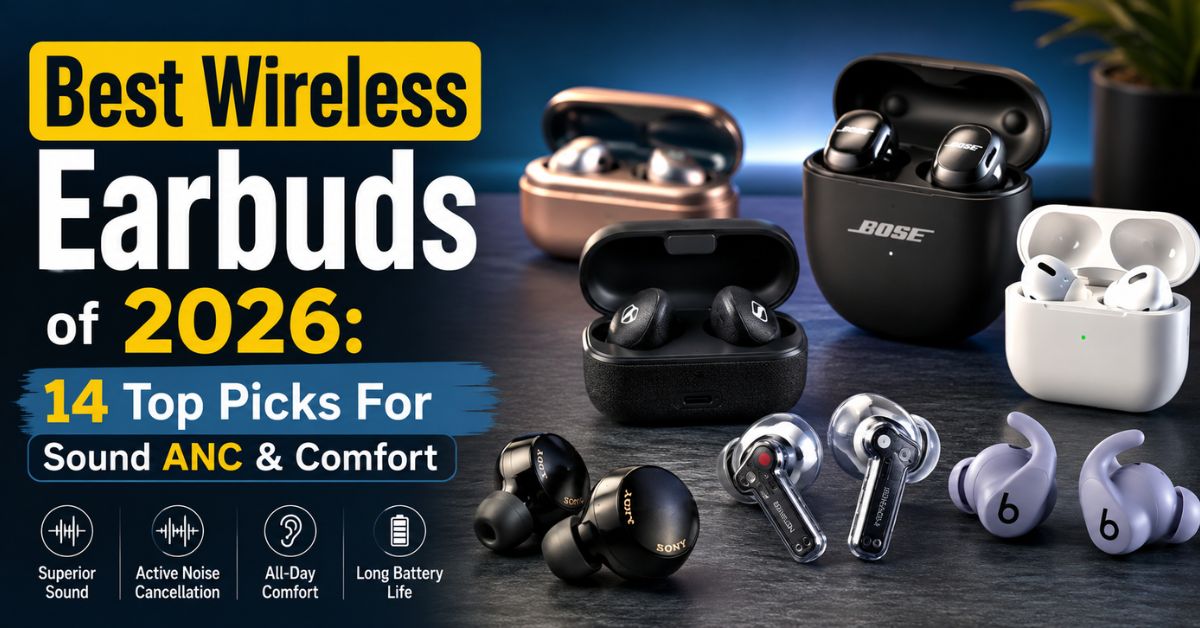
Best Wireless Earbuds Of 2026: 14 Top Picks For Sound ANC & Comfort
Shopping for wireless earbuds in 2026 feels a bit like walking into a candy store with too many flavors. Every brand claims the best sound quality. Every box says “all-day comfort.” And every ad promises the strongest active noise cancellation you’ve ever heard. It’s a lot of noise, and not the kind these earbuds are supposed to cancel.
This guide cuts through that noise. We tested the best wireless earbuds of 2026 in real conditions. Loud trains. Quiet offices. Long flights. Sweaty gym sessions. We looked at sound quality, battery life, microphone quality, and comfort. No guesswork. No marketing fluff. Just real results, so you can pick the right pair of true wireless earbuds for your life, your phone, and your budget.
Quick Comparison of the Best Wireless Earbuds in 2026
If you’re short on time, this table gives you the fast answer. It shows the best noise cancelling earbuds, the best Bluetooth earbuds for calls, and the best value earbuds, all in one place. Every price reflects average U.S. retail in 2026.
| Model | Best For | Price | ANC Rating | Battery (Buds/Total) |
| Sony WF-1000XM6 | Best Overall | $329.99 | Best-in-Class | 8 hrs / 24 hrs |
| Apple AirPods Pro 3 | Best for iPhone | $249 | Excellent | 8 hrs / 24 hrs |
| Samsung Galaxy Buds4 Pro | Best for Samsung | $249.99 | Very Good | 6-8 hrs / 24+ hrs |
| Technics EAH-AZ100 | Best for Android | $299.99 | Very Good | 7 hrs / 24 hrs |
| Bose QuietComfort Ultra Gen 2 | Best Noise Cancelling | $299 | Excellent | 6 hrs / 24 hrs |
| Beats Powerbeats Pro 2 | Best for Workouts | $249.99 | Good | 10 hrs / 45 hrs |
| CMF Buds 2 Plus | Best Budget | $69 | Good | 10 hrs / 60+ hrs |
| EarFun Air Pro 4+ | Best Under $100 | $99.99 | Good | 6-12 hrs / varies |
| Bowers & Wilkins Pi8 | Best Premium | $499 | Very Good | 5-7 hrs / varies |
| Shokz OpenFit 2 | Best Open-Ear | ~$180 | None (Open-Ear) | 7 hrs / 28 hrs |
No single pair wins every category, and that’s the whole point of this guide. Your ideal pick depends on how you actually use your earbuds, not just which spec sheet looks the most impressive.
How We Tested and Chose the Best Wireless Earbuds
Picking a winner isn’t about who shouts the loudest in a press release. We judged every pair on things that matter once they’re actually in your ears. That means real commutes, real gym sessions, and real work calls, not just a quiet lab room for five minutes.
We also looked closely at the companion app for each pair, since software now shapes so much of the listening experience. A good app unlocks EQ customization, fit tests, and firmware updates that improve performance over time. A bad app just gets in the way. Here’s exactly what we tested for, category by category.
Noise Cancellation and Transparency Testing
We tested active noise cancellation in layered, noisy spaces. Think airplane cabin drone, screeching train brakes, and loud café chatter. Each environment stresses a different part of the ANC system, and cheap earbuds usually fall apart in at least one of them.
We also paid close attention to transparency mode, sometimes called ambient sound mode. This feature lets outside noise in on purpose, which matters more than people think. If you’re walking near traffic or waiting for an announcement at a gate, you want quick, natural-sounding awareness, not a muffled, robotic version of the real world.
Sound Quality and Audio Performance
We played a wide mix of music through every pair to judge audio performance properly. Bass-heavy hip-hop. Vocal-driven acoustic tracks. Dense orchestral pieces with dozens of instruments layered together. This mix exposes weak drivers fast, since cheap earbuds often sound fine with simple pop songs but fall apart with anything complex.
We also checked Bluetooth codecs, since this affects sound quality more than most people realize. Support for high-resolution audio through LDAC or aptX Adaptive makes a real difference compared to basic AAC. We listened closely for bass response, crisp treble, clear vocals, and detailed mids across every track, chasing a balanced audio signature rather than one that sounds exciting for thirty seconds and tiring after ten minutes.
Comfort, Fit and Long-Term Wear
Comfortable wireless earbuds only earn that title after hours of wear, not five minutes in a store. We tested each pair across full workdays and long train rides. We checked ear tip fit, wing-tip stabilizers, and the actual weight sitting in each ear canal.
Comfort is personal, and what fits one ear shape perfectly might feel wrong for someone else. That’s why we paid close attention to how many tip sizes each brand includes, and whether the design actually delivers on promises of all-day comfort. A secure fit on paper doesn’t always survive a bumpy subway ride in real life.
Battery Life and Charging Tests
Claims about battery life on the box rarely match real-world results. We tracked single-charge playback time with ANC turned on, plus total runtime from the charging case. These two numbers tell very different stories, and brands often blur them together in marketing copy.
We found that long battery life earbuds in 2026 typically hit 6 to 8 hours per charge with ANC running, and 20 to 60-plus hours total once you count the case. We also tested fast charging claims, since a quick 10-minute top-up before you leave the house should actually deliver a useful chunk of extended playback, not just a token 20 minutes.
Read More: Best Wireless Earbuds Under 200 $ 2024: 10 Picks for Sound & Comfort
Microphone and Call Quality Testing
Call quality has improved a lot across the board in 2026. We tested calls in wind, traffic, and crowded rooms to judge voice pickup and how well each pair’s microphones isolate speech from background noise. Earbuds for calls now often rely on AI-based noise suppression instead of basic mic arrays.
Microphone quality varies a lot between models. Some pairs make you sound like you’re in a quiet room even while standing on a windy street corner. Others let every passing car bleed straight into the call. We tested every pair for genuine hands-free calling, not just casual music listening.
Connectivity, Controls and App Features
Bluetooth connectivity stability matters just as much as sound quality, so we tested drop-out rates across crowded areas like train platforms and busy offices. We also tested multipoint connectivity, which allows seamless device switching between a laptop and a phone without manually disconnecting each time.
We compared touch controls against physical controls for reliability, since accidental taps are one of the most annoying everyday earbud problems. Finally, we dug into each companion app to check for EQ customization, firmware update frequency, and any extra smart features worth knowing about before you buy.
The 10 Best Wireless Earbuds of 2026
Now for the main event. Below are ten standout pairs of wireless earbuds, covering every price point and every type of listener. Each one earned its spot through real testing, not hype.
Sony WF-1000XM6 Best Overall Wireless Earbuds
Sony’s flagship true wireless earbuds officially launched in early 2026, and they immediately became the benchmark for best noise cancelling earbuds on the market. A new processor handles noise reduction with real precision, using eight adaptive microphones to block a wide range of frequencies, from low engine rumble to sharp office chatter.
Sound quality here is genuinely excellent, with support for high-resolution audio through LDAC and spatial audio with head tracking for movies and shows. Battery life holds steady at 8 hours per charge and 24 hours total, and the charging case, while a bit bulkier than before, still fits most pockets fine. At $329.99, it’s the priciest pick on this list, but if pure audio performance paired with class-leading ANC is your top priority, nothing else beats it right now.
Apple AirPods Pro 3 Best Wireless Earbuds for iPhone
For anyone deep inside the Apple ecosystem, this is the easy pick. iPhone compatibility here goes far beyond simple pairing. Apple reworked the internal design using data from thousands of ear scans, and it shows in the fit, with five tip sizes covering nearly every ear shape.
Active noise cancellation improved significantly over the previous generation, and real-world testing backs up Apple’s bold claims. You also get heart rate sensing, water resistance strong enough for workouts, and Live Translation. Battery life reached 8 hours per charge with ANC on. The catch is ecosystem lock-in, since several standout features work only on iPhone, and there’s no LDAC support for Android users chasing richer high-resolution audio.
Samsung Galaxy Buds4 Pro Best Earbuds for Samsung
Samsung built this pair specifically for its own phones, and the Samsung ecosystem integration really shows. A new two-way speaker system separates bass and treble cleanly, giving music a fuller, more layered feel than the previous generation managed.
Active noise cancellation here adapts in real time to your surroundings, and six microphones work together for genuinely clear voice pickup during calls. You also get head-gesture controls and Hi-Res 24-bit audio, but only when paired with a compatible Galaxy phone. That’s the tradeoff with earbuds for Samsung devices specifically: incredible when matched with the right phone, less exciting otherwise.
Read More: JoinCRS com: Complete Guide, Code & How It Works in 2026
Technics EAH-AZ100 Best Wireless Earbuds for Android
Technics quietly built one of the strongest options for Android compatibility without leaning on flashy marketing. Soft, rectangular nozzles fit comfortably into most ear shapes, and support for both LDAC and LC3 codecs covers high-resolution audio and everyday battery efficiency equally well.
Three-way multipoint connectivity lets you stay linked across several devices at once, which is rare even among premium premium wireless earbuds. Battery life reached over 10 hours in testing, among the longest we measured at this price point. Stock tuning leans a little dark and bass-heavy, so budget a few minutes in the app to dial in the EQ. Once adjusted, it’s a genuinely strong all-rounder for Android users who want more than the big two brands offer.
Bose QuietComfort Ultra Earbuds Gen 2 Best Noise-Cancelling Earbuds
If one word defines this pair, it’s isolation. Bose built its reputation on active noise cancellation, and the Gen 2 QuietComfort Ultra earbuds push that reputation further with a custom calibration process that adjusts noise cancellation to your unique ear shape.
The result is genuinely immersive environmental noise reduction that blocks out airplane engines and city traffic without flattening the music underneath. A Cinema Mode adds width to movies for immersive listening, which feels useful on long flights. The tradeoff is battery life, sitting at a modest 6 hours per charge, and a slightly bulkier earbud shape than some rivals. Still, for travelers chasing the strongest ANC available, this pair earns its spot.
Beats Powerbeats Pro 2 Best Wireless Earbuds for Workouts
For anyone who needs workout earbuds that actually stay put, this pair is the clear standout. The ear-hook design eliminates slipping during even the most intense training session, making these genuinely gym-ready earbuds rather than regular earbuds wearing a sporty label.
A built-in heart rate monitor adds real fitness value, using the same optical sensor technology found in popular smartwatches. Active noise cancellation here reduces outside distraction well, and battery life stretches up to 10 hours per charge with 45 hours total from the case. There’s no multipoint and limited EQ, and Android users lose some smarter features, but for running earbuds that won’t fall out mid-sprint, nothing else on this list comes close.
CMF Buds 2 Plus Best Budget Wireless Earbuds
Few pairs deliver this much value for this little money. As budget wireless earbuds go, the CMF Buds 2 Plus punch well above their price class, offering sound quality and ANC performance that genuinely competes with pairs costing twice as much.
Active noise cancellation reaches an impressive rating for the price, and LDAC support means you’re not sacrificing audio performance just because you spent less. Battery life is a real strength too, hitting roughly 60 hours of extended playback once you count the case. Call quality is the one area where the budget roots show, since busy streets and windy days can muddy your voice a little. Even so, for anyone shopping on a tight budget who still wants real ANC, this is likely the smartest purchase on the entire list.
EarFun Air Pro 4+ Best Wireless Earbuds Under $100
The EarFun Air Pro 4+ prove that wireless earbuds under $100 don’t have to feel like a compromise. A dual-driver system delivers genuinely good treble clarity, and the default sound signature tracks closely to what most listeners actually prefer, right out of the box.
On top of solid sound quality, you get modern connectivity through the newest Bluetooth standard, aptX Lossless support, and a full ten-band EQ for customizable sound profile tweaking. Active noise cancellation is solid rather than class-leading, and battery life came in a bit below the rated spec during testing. Even with those small caveats, at under $100, this pair beats plenty of pricier competitors on pure feature count.
Read More: Latest FeedBuzzard Com: Complete Features & Trends Guide 2026
Bowers & Wilkins Pi8 Best Premium Wireless Earbuds
If you want the best-sounding premium wireless earbuds money can buy, this pair is a serious contender. Custom drivers paired with advanced internal processing deliver a genuinely refined, detailed mids and deep bass package that few rivals can match.
The standout feature is a transmitter case, letting you pipe audio wirelessly from almost any source, including in-flight entertainment systems, straight to your ears using premium Bluetooth codecs. At $499, this pair sits firmly in luxury territory, and battery life runs shorter than most rivals at this price. But for anyone chasing a genuinely premium audio experience with unique functionality, few pairs offer the same complete package.
Shokz OpenFit 2 — Best Open-Ear Earbuds for Calls and Awareness
This pair takes a completely different approach to comfort. As open-ear earbuds, they rest gently on the outer ear rather than sealing into the canal, leaving you fully aware of everything happening around you.
Comfort is the entire point here, and it genuinely delivers, with zero pressure buildup even after hours of wear. That makes this pair excellent commuting headphones for walkers, cyclists, and parents who need constant situational awareness. Voice pickup during calls is surprisingly strong for the design too. The obvious tradeoff is a total lack of active noise cancellation, so these aren’t the right pick for flights or loud subway rides, but for everyday awareness paired with decent sound, this open-ear concept fills a real gap.
Which Wireless Earbuds Are Best for You?
Specs only tell part of the story, since the right pair really depends on how you use earbuds day to day. A frequent flyer has completely different needs than someone who mostly takes calls from a home office. Let’s break this down by real-world use case.
The good news is that most listeners fall clearly into one or two of these categories, which makes narrowing down your shortlist much easier. Read through each one honestly, and you’ll likely already know which pair from our list deserves your money.
Best Earbuds for Travel and Airplane Noise
For flights and long train rides, wireless earbuds for travel need strong active noise cancellation above almost everything else. The Sony WF-1000XM6 and Bose QuietComfort Ultra Gen 2 lead this category clearly, since both block engine drone and cabin noise better than any rival tested here.
Best Earbuds for Work, Meetings and Phone Calls
If your earbuds double as a daily work tool, earbuds for calls need standout microphone quality above all else. The Bose QC Ultra Gen 2 and Samsung Galaxy Buds4 Pro both filter background noise impressively well, making either pair a smart choice for back-to-back video calls.
Best Earbuds for Gym and Running
Sweat resistance and a secure ear fit matter most in this category. The Powerbeats Pro 2 and AirPods Pro 3 both bring rugged builds and snug designs, making them genuinely excellent workout earbuds and running earbuds for daily training.
Best Earbuds for Music and Audiophile Listening
When sound quality outranks everything else, the Sony WF-1000XM6 and Bowers & Wilkins Pi8 both stand out as true audiophile earbuds. Detailed mids, deep bass, and crisp treble make long listening sessions genuinely enjoyable rather than fatiguing.
Best Earbuds for Everyday Commuting
For walking commutes where awareness matters, the Shokz OpenFit 2 shines thanks to its open-ear earbuds design. For budget-conscious commuters who still want strong battery life, the CMF Buds 2 Plus delivers excellent value as reliable commuting headphones.
What to Look for When Buying Wireless Earbuds
Before any “best of” list matters much, it helps to understand what actually separates good Bluetooth earbuds from forgettable ones. These are the features worth checking closely, no matter which pair you end up choosing.
Getting these basics right matters more than chasing a flashy brand name. A cheaper pair with the right combination of fit, battery, and ANC will beat an expensive pair that doesn’t match your actual needs.
Active Noise Cancellation: How Much ANC Do You Need?
Not all active noise cancellation systems work the same way. Adaptive audio and adaptive ANC adjust strength automatically based on your surroundings, while fixed ANC applies the same level everywhere you go. Budget pairs often manage solid background noise blocking, while flagship models push noticeably further into true environmental noise reduction.
Sound Quality, Codecs and Frequency Response
Bluetooth codecs quietly shape how good your music actually sounds. Basic SBC and AAC work fine for casual listening, but wireless earbuds with ANC that also support LDAC or aptX Adaptive unlock noticeably richer detail for high-resolution audio. A good frequency response curve matters too, since it determines whether bass, mids, and treble sound naturally balanced audio rather than lopsided.
Battery Life: What the Real-World Numbers Mean
Always check two numbers separately: playback time per charge, and total time including the charging case. A pair advertising “30 hours of battery” might mean just 6 hours on the earbuds themselves, with the rest coming from repeated case recharges throughout the day rather than one single extended playback session.
Ear Tip Fit, Comfort and Secure Placement
More tip sizes generally mean a better ear tip fit for more people. Wing-tip stabilizers add extra security during movement, which matters most for workout earbuds. If a brand only includes three tip sizes, expect a less reliable seal than brands offering five or more, and a weaker path to genuine all-day comfort.
Water and Sweat Resistance Ratings
These ratings follow a clear scale. Water resistance rated IPX4 handles splashes and light rain fine, while a higher IP57 rating survives much heavier sweat resistance demands and even brief submersion. Check this rating carefully if workouts or outdoor runs are part of your daily routine.
| Rating | What It Handles | Good For |
| IPX4 | Light splashes, sweat | Casual daily use |
| IP54 | Dust and moderate water | Light workouts, commuting |
| IP57 | Heavy sweat, brief submersion | Intense workouts, running in rain |
Multipoint Bluetooth and Device Switching
Multipoint connectivity lets your earbuds stay connected to two devices at once, like a laptop and a phone. This matters enormously for hybrid workers who jump between a video call and a personal call throughout the day. It enables true seamless device switching without the annoying manual reconnect step.
Companion Apps, EQ and Customization
A strong companion app extends the life of your earbuds long after purchase. Good apps unlock EQ customization, fit tests, and firmware updates that sometimes meaningfully improve active noise cancellation or call quality months after you bought the earbuds, giving you a genuinely customizable sound profile over time.
Wireless Charging and USB-C: Is It Worth Having?
Wireless charging adds convenience if you already own a charging pad, letting you top up the case without hunting for a cable. USB-C charging has become the standard across nearly every brand now, and fast charging support means even a short stop at your desk can add hours of extended playback before you head out the door.
Auracast and Bluetooth LE Audio: Do You Need Them?
Bluetooth LE Audio improves overall efficiency and sound quality at lower power draw, which benefits battery life across the board. Auracast builds on that by letting compatible earbuds tune into public broadcast audio, like gym TVs or airport announcements. It’s still an emerging feature, but one worth checking if you want future-proof wireless audio technology.
How to Choose Wireless Earbuds for Your Phone
Not every pair of wireless earbuds plays equally well with every phone. Some features are locked to a specific ecosystem, and knowing this upfront saves you from paying for functionality you’ll never actually use.
This section breaks compatibility down by platform, so you can match your next pair to the phone actually sitting in your pocket right now.
iPhone and Apple Ecosystem Compatibility
iPhone compatibility benefits enormously from staying inside the Apple ecosystem, since features like automatic switching and Find My integration only work fully on Apple hardware. Audio latency also stays lower when using Apple-made earbuds with an iPhone, which matters for watching video or gaming.
Android and Google Pixel Compatibility
Android compatibility generally opens the door to more Bluetooth codecs, including LDAC and aptX, giving you richer high-resolution audio than most iPhone setups allow. Google Pixel compatibility specifically adds smart assistant integration, letting you ask questions or get directions hands-free without touching your phone.
Samsung Galaxy Compatibility and Features
The Samsung ecosystem rewards loyalty heavily, unlocking Hi-Res audio, seamless device switching, and deep software integration exclusively for Galaxy phone owners. Non-Samsung Android users can still use these earbuds fine, but they’ll miss out on several standout features built specifically for that ecosystem.
Wireless Earbuds vs. Wireless Headphones: Which Should You Buy?
This comparison comes up constantly, and honestly, both formats bring real advantages to the table. In-ear wireless headphones win clearly on portability and discretion, slipping easily into a pocket without messing up your hair or glasses.
Over-ear wireless headphones, on the other hand, often win on raw isolation and battery life, thanks to bigger ear cups and more room for larger batteries inside. If pure performance always beats convenience for you, headphones still hold a real edge. But for most people, most of the time, the sheer convenience of completely wireless earbuds wins out.
Earbuds vs Headphones for Travel
For travel-friendly earbuds, portability matters enormously, since they pack down small and slip easily into a jacket pocket. Headphones offer stronger passive isolation but take up noticeably more luggage space.
Earbuds vs Headphones for Sound Quality
Larger headphone drivers generally produce deeper bass response and a wider soundstage. That said, top-tier true wireless earbuds have closed this gap significantly over the past few years.
Earbuds vs Headphones for Comfort and Battery Life
Headphones often win on pure battery life, frequently stretching past 30 hours per charge thanks to bigger internal batteries. Earbuds win on lightweight all-day wearability, especially during cord-free listening sessions where head pressure becomes a real factor over time.
Are Expensive Wireless Earbuds Worth It?
This is the question everyone eventually asks while staring at a $300 price tag next to a $50 one. The honest answer depends heavily on how you actually use your earbuds day to day, not on how impressive the box looks on a store shelf.
Premium pricing does buy real advantages, but budget models have closed much of that gap faster than most shoppers realize.
What You Get From Premium Earbuds
Premium wireless earbuds genuinely buy you stronger ANC chips, broader Bluetooth codecs, and noticeably better call quality overall. If you fly often, spend hours on calls, or care deeply about immersive listening, that price difference earns its keep quickly.
When Budget Earbuds Are the Better Choice
For casual daily listening, podcasts, and the occasional call, a well-reviewed budget wireless earbuds pair now delivers performance that would have seemed impossible just a few years back. The CMF Buds 2 Plus alone proves that strong ANC no longer requires flagship pricing.
Wireless Earbuds Buying Guide: Which Features Matter Most?
With so many specs competing for attention, it helps to prioritize based on your actual budget tier rather than trying to chase every feature at once.
This final buying breakdown ties everything in this guide together into one simple, practical framework.
Best Features to Prioritize at Different Budgets
| Budget Tier | Priority Features |
| Under $100 | Solid battery life, basic ANC, comfortable fit |
| $100–$250 | Strong ANC, good codecs, companion app with EQ |
| $250+ | Class-leading ANC, premium drivers, multipoint, extra smart features |
Which Earbuds Offer the Best Overall Value?
Among everything tested, the CMF Buds 2 Plus and EarFun Air Pro 4+ stand out clearly as the best value earbuds, delivering flagship-adjacent performance without the flagship price tag attached.
Frequently Asked Questions
Are Wireless Earbuds Good for Phone Calls?
Yes, especially flagship models with AI-based noise suppression. These pairs isolate your voice impressively well, even in windy or noisy environments, making them genuinely reliable for hands-free calling throughout a busy day.
How Long Should Wireless Earbud Batteries Last?
In 2026, 6 to 8 hours per charge with ANC turned on is the standard for flagship pairs. Total battery life including the case typically ranges from 20 hours on budget models up to 60-plus hours on standout pairs.
Are Expensive Earbuds Better Than Budget Earbuds?
Generally yes, particularly for ANC depth and call quality. However, budget models have improved dramatically, and the gap has narrowed more than most shoppers expect.
Will Wireless Earbuds Work With Any Phone?
Most Bluetooth earbuds pair fine with any modern smartphone. That said, certain premium features often require a matching ecosystem, like an iPhone, Galaxy phone, or Pixel device, to unlock their full potential.
Do Wireless Earbuds Need Noise Cancellation?
Not always. If situational awareness matters more to you, open-ear earbuds without ANC might actually suit your lifestyle better than a sealed, noise-cancelling design.
Conclusion
After weeks of real-world testing, a few clear winners emerge depending on exactly what you need. If you want one pair that handles almost everything well, the Sony WF-1000XM6 remains the top overall pick among the best wireless earbuds of 2026. iPhone owners should look straight at the AirPods Pro 3, while anyone on a tight budget should seriously consider the CMF Buds 2 Plus.
There’s no single “best” pair for everyone, and that’s genuinely good news. Whatever you value most, whether that’s all-day comfort, flagship ANC, or simply not overspending, there’s a great option waiting in this list. Pick the one that matches how you actually live, not the one with the flashiest spec sheet, and you’ll be happy with your wireless earbuds for years to come.

Ryan Mitchell is a writer and language enthusiast at MeaningZen. He creates simple guides on slang, word meanings, grammar, and modern internet language. His goal is to make confusing words and phrases easy to understand.