
Geometry Learn V3: Easy Guide to Shapes, Angles & More (2026)
Geometry can feel hard at first. But it does not have to stay that way. Geometry Learn V3 breaks geometry down into small, easy steps. You learn shapes and angles the simple way. No stress. No confusion.
This guide covers everything. You will learn geometry basics, angle measurement, geometric shapes, and real geometry formulas. Each section uses short sentences and clear examples. By the end, geometry will feel much less scary.
What Is Geometry Learn V3?
Geometry Learn V3 is a simple system for geometry learning. It helps you understand geometry concepts step by step. You do not need to memorize everything at once. You build knowledge slowly, the way you learn any new skill.
This geometry guide focuses on visual learning. You see a shape first. Then you learn its rules. This method makes geometry lessons stick in your memory much longer than plain formulas do.
The Purpose of Geometry Learn V3
The main goal is simple. Geometry Learn V3 wants you to understand why geometry works, not just memorize how. This matters because real understanding lasts. Memorized facts fade fast.
Think about a bridge. Engineers use triangles in bridge design. Triangles spread out force evenly. This is not random. It is applied geometry fundamentals at work. As one geometry teacher once said, “Geometry is the language of space. Once you speak it, the world makes more sense.” That idea sits at the heart of this geometry tutorial.
How Geometry Learn V3 Makes Geometry Easier
Old-style geometry lessons often start with formulas. That approach confuses many students. Geometry Learn V3 flips the order. You start with shapes you can see. Then angles you can measure. Then patterns you can spot on your own.
This order matters a lot for learn geometry success. Your brain likes patterns more than raw numbers. So when you see the pattern first, the formula makes sense later. This is why so many students find this geometry guide easier than a normal textbook.
Key Geometry Skills You Can Build
Working through this geometry guide builds real skills. You improve your spatial reasoning. You get better at geometric reasoning too. Both skills help far beyond math class.
You also improve measurement accuracy. This means you read angles and shapes more correctly over time. Geometry skills like these help with art, sports, building projects, and even video games. Good geometry practice builds a sharper eye for detail in daily life.
Geometry Basics You Need to Know
Before jumping into shapes, you need strong geometry fundamentals. Every shape in geometry starts from a few tiny building blocks. Learn these first. Everything else becomes much easier.
This section covers points, lines, line segments, rays, and planes. These ideas sound simple. But they form the base of all basic geometry. Skip them, and later lessons feel shaky.
Points, Lines, and Line Segments
A point marks one exact spot. It has no size and no width. A dot on a map is a point. A star on a night sky chart is a point too. Even GPS location markers are just points in disguise.
A line runs forever in both directions. It never stops. A line segment is different. It has a clear start and a clear end, like the edge of a table. The table below shows the difference clearly.
| Concept | Meaning | Example |
| Point | A single, exact location | A dot on a map |
| Line | Goes on forever, both ways | A straight horizon |
| Line segment | Has a fixed start and end | The edge of a book |
Rays and Planes
A ray starts at one point and then goes on forever in just one direction. Sunlight beams work like rays. They start at the sun and travel outward without stopping. This idea helps later when you study angles, since every angle is made from two rays meeting at a point.
A plane is a flat surface with no thickness at all. A sheet of paper is close to a plane. A wall is close to a plane too. In plane geometry, we treat these flat surfaces as perfect and endless, even though real objects are not.
See Also: Geekzilla Tio Geek: Complete Guide to Tech & Geek Culture 2026
Why Geometry Basics Matter
These basic ideas connect to everything else in geometry. Shapes are built from lines. Angles are built from rays. Even circles rely on points, since every point on a circle sits the same distance from the center.
If you skip these basics, later lessons feel confusing. But if you learn them well, elementary geometry becomes smooth and simple. Strong basics make every future lesson easier to follow.
Understanding Angles Step by Step
Angles sit at the center of geometry. Once you understand angles, shapes make much more sense. This section walks through angles in small, easy steps.
You will learn what an angle is, the different types of angles, how to measure them, and where you see them in daily life. This is one of the most useful parts of any geometry tutorial.
What Is an Angle?
An angle forms when two lines or rays meet at one point. That meeting point is called the vertex. You see angles constantly without noticing them. A door opening forms an angle. Scissors cutting paper form an angle. Clock hands form an angle too.
Understanding this simple idea unlocks a big part of geometry concepts. Once you can spot an angle, you can start measuring it and classifying it.
Types of Angles
Angles come in several types, based on their size. Learning these types is a key part of angle measurement. The table below sums up the main types clearly.
| Angle Type | Size Range |
| Acute angle | Less than 90 degrees |
| Right angle | Exactly 90 degrees |
| Obtuse angle | Between 90 and 180 degrees |
| Straight angle | Exactly 180 degrees |
| Reflex angle | More than 180 degrees |
How to Measure Angles
You measure angles with a tool called a protractor. First, place the center point of the protractor on the vertex. Next, line up the base of the protractor with one side of the angle. Then read the number where the other side crosses the scale.
This process feels tricky at first. But with practice, angle measurement becomes quick and natural. Geometry practice with a real protractor helps far more than just reading about it.
Angle Examples in Everyday Life
You can find angle examples all around your home and city. A skateboard ramp often forms an acute angle with the ground. A building corner usually forms a right angle. An open door often creates an obtuse angle between the door and the wall.
These small, real examples make angles easier to remember. This is one goal of good geometry examples: connect the math to real things you already see every day.
Angle Relationships You Should Know
Angles do not just exist alone. They often relate to each other in special ways. Learning these geometric relationships makes solving problems much faster.
This section covers four key angle pairs. Once you know these rules, many geometry problems become simple math instead of guesswork.
Complementary Angles
Complementary angles are two angles that add up to exactly 90 degrees. For example, a 30-degree angle and a 60-degree angle together form a complementary pair. This rule shows up often in construction and design layouts, where right angles need splitting into smaller parts.
Once you spot one angle in a complementary pair, finding the second one is easy. Just subtract from 90. This small trick saves a lot of time during geometry problems.
Supplementary Angles
Supplementary angles are two angles that add up to exactly 180 degrees. A 110-degree angle and a 70-degree angle form a supplementary pair, for example. This rule connects closely to straight lines, since a straight line always measures 180 degrees.
Many real-world layouts use supplementary angles without people noticing. Road intersections and roof designs both rely on this simple geometry rule.
Adjacent Angles
Adjacent angles share one vertex and one side. They sit right next to each other, without overlapping. Picture two pizza slices sitting side by side. They share one cut line and one center point. That is exactly how adjacent angles work.
Adjacent angles are not always equal. But they often work together with other angle rules to help solve bigger geometry problems.
Vertical Angles
Vertical angles form when two lines cross each other. This crossing creates two pairs of opposite angles. Here is the key rule to remember: vertical angles are always equal in size, every single time.
This rule is one of the strongest and most reliable facts in all of geometry. Many geometry test questions rely on this one simple fact.
Parallel Lines and Angle Rules
Parallel lines never touch, no matter how far they extend. That sounds simple. But when another line crosses them, powerful angle patterns appear. This section explains those patterns clearly.
Understanding parallel lines unlocks a whole new set of tools for solving geometry problems quickly and correctly.
Important Angle Pairs
When a line crosses two parallel lines, it creates several special angle pairs. Alternate angles turn out equal. Corresponding angles match each other too. Interior angles often add up to a fixed, predictable sum.
These angle pairs make understanding parallel lines much easier. Once you know the pattern, you can solve for missing angles without much guesswork at all.
How Parallel Lines Help Solve Problems
Parallel line rules save a lot of time. If you know just one angle in the pattern, you can often find every other angle using the rules above. This skill is a core part of strong geometry problem-solving skills.
Students who master this topic usually find later geometry topics, like polygons and triangles, much easier to handle. The angle rules repeat again and again throughout geometry.
Parallel Lines in Real Life
You can spot parallel lines almost everywhere once you start looking. Railway tracks run parallel to each other. Road markings use parallel lines for lane guides. Window frames often use parallel lines for a clean, balanced look.
This is a great example of real-world geometry. The math you learn in this section shows up in construction, transportation, and product design every single day.
Polygons and Their Properties
A polygon is a closed shape made from straight sides. Triangles, squares, and hexagons are all examples of polygons. This section explains the basics clearly.
Understanding shape properties here builds a strong base for the triangle and quadrilateral sections that follow soon.
What Is a Polygon?
A shape counts as a polygon only if it is closed and made entirely of straight lines. A circle is not a polygon, since it has no straight sides. A triangle is a polygon, since it closes fully with three straight sides.
This simple definition helps with shape classification later on. Once you know what makes a polygon, sorting shapes becomes much faster.
Common Types of Polygons
Polygons get their names from their number of sides. A triangle has three sides. A quadrilateral has four sides. A pentagon has five sides, and a hexagon has six sides. The table below sums this up clearly.
| Polygon Name | Number of Sides |
| Triangle | 3 |
| Quadrilateral | 4 |
| Pentagon | 5 |
| Hexagon | 6 |
Regular vs. Irregular Polygons
A regular polygon has equal sides and equal angles all around. An irregular polygon has sides or angles that are not equal. A honeycomb is a great case study here. Bees build honeycombs from regular hexagons because that shape packs together with almost no wasted space.
This small case study shows how geometry in nature often follows the most efficient path possible, long before humans ever studied the math behind it.
Triangles Explained Simply
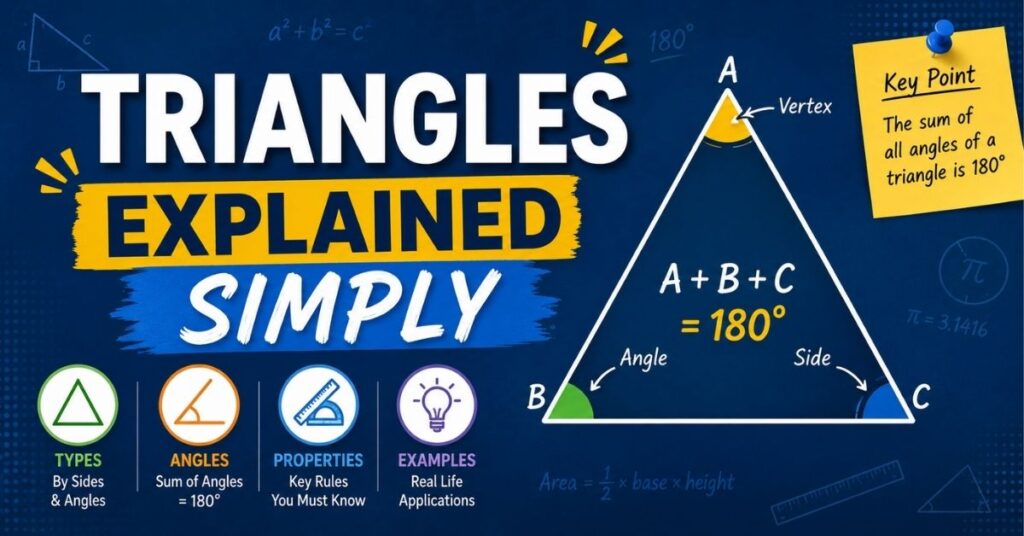
Triangles are one of the strongest shapes in all of geometry. Engineers use them constantly in geometry in engineering projects. This section breaks triangles down into simple, clear groups.
You will learn triangle classification by side length, by angle type, and the famous triangle angle sum rule that never changes.
Types of Triangles by Sides
An equilateral triangle has three equal sides. An isosceles triangle has exactly two equal sides. A scalene triangle has no equal sides at all. These three types cover every triangle shape based purely on side length.
Knowing this grouping helps a lot with geometry problems that ask you to sort or describe triangle shapes quickly.
Types of Triangles by Angles
A right triangle has one angle that measures exactly 90 degrees. An acute triangle has every angle under 90 degrees. An obtuse triangle has one angle over 90 degrees. This second grouping works alongside the side-length grouping above.
Together, these two systems give you a full and clear way to describe any triangle you see.
The Triangle Angle Sum Rule
Here is one of the most important facts in geometry: every triangle’s three angles always add up to exactly 180 degrees. This rule never changes, no matter the triangle’s size or shape.
This triangle angle sum rule connects back to parallel lines, since the proof relies on angle pairs formed by a line running parallel to one side of the triangle.
Triangle Examples in Real Life
Triangles show up constantly in strong, stable structures. Roof designs use triangles for support. Bridges use triangles to spread out weight evenly. Even mountain slope calculations rely on triangle math.
A famous case study is the Eiffel Tower. Its frame uses many small triangles working together. This design helps the tower resist strong wind pressure without bending or breaking.
See Also: Stay Updated Always TXEPC (2026): Smart Guide to Critical Updates
Quadrilaterals and Their Properties
A quadrilateral is any closed shape with four straight sides. Many common shapes fall under this group. This section explains the most important ones clearly, using simple, short descriptions.
Learning quadrilateral properties helps you sort and understand shapes faster in daily life and in schoolwork.
Squares and Rectangles
A square has four equal sides and four right angles. A rectangle has four right angles too, but only opposite sides need to match in length. So every square is a rectangle, but not every rectangle is a square.
This small difference confuses many students at first. But once you see it clearly, it becomes an easy rule to remember for good.
Parallelograms
A parallelogram has two pairs of parallel sides. Opposite sides stay equal in length as well. You see parallelograms in sliding doors and in many mechanical systems, where parts need to move evenly along parallel tracks.
This shape connects closely back to the parallel line rules covered earlier in this geometry guide.
Rhombuses
A rhombus has four equal sides, much like a square. But its angles are not equal to 90 degrees. Picture a square that has been pushed sideways slightly. That tilted shape is a rhombus.
This shape often confuses students who assume equal sides always mean equal angles. In geometry, that assumption is not always true.
Trapezoids
A trapezoid has just one pair of parallel sides. The other two sides are not parallel at all. You see trapezoids in bridge supports and in certain furniture designs, where a wider base needs to narrow toward the top.
Trapezoids complete the main group of common quadrilaterals covered in this section.
Circles Made Easy
Circles are perfectly round shapes with no straight sides and no corners at all. This section covers the key terms and circle measurements you need to know.
Understanding circles matters for daily life, since wheels, coins, and clocks all rely on circular design.
Important Circle Terms
Every circle uses a few key terms. The radius runs from the center point out to the edge. The diameter runs all the way across the circle, through the center. The circumference is the full distance around the outside edge.
Two more terms matter too. An arc is a curved part of the circle’s edge. A sector is a slice of the circle, similar to a slice of pie.
Radius, Diameter, and Circumference
These three terms connect closely together. The diameter is always exactly twice the length of the radius. The circumference depends on both, using a special number called pi, written as the symbol π.
Pi is roughly equal to 3.14. This number stays the same for every circle, no matter how big or small the circle is.
Basic Circle Formulas
Two formulas matter most for circles. The table below lists them clearly for quick reference.
| Formula Name | Formula |
| Circumference | 2 × π × radius |
| Area | π × radius × radius |
Circles in Everyday Life
Circles appear constantly in daily life. Wheels use circles to roll smoothly. Coins use circles for easy handling and stacking. Clocks use circles to show time in a clear, even way around the full face.
This is another strong example of real-world geometry, where simple shapes solve everyday problems in smart, efficient ways.
Perimeter, Area, and Measurement
Perimeter and area often get confused. But they measure two very different things. This section explains both clearly, along with common measurement mistakes to avoid.
Good geometry measurements matter in real life too, from home projects to school tests.
How to Find Perimeter
Perimeter measures the total distance around the outside of a shape. Think about a fence built around a yard. The fence follows the full outer edge of the space. That total distance is the perimeter.
You find perimeter by adding up the length of every side of the shape. This works for any polygon, no matter how many sides it has.
How to Calculate Area
Area measures the space inside a shape, not the distance around it. Think about carpet covering a floor. The carpet fills the inside space completely. That total inside space is the area.
Different shapes use different area formulas. But the basic idea always stays the same: area measures the filled space, not the outer edge.
Choosing the Right Units
Units matter a lot in geometry measurements. Perimeter uses simple length units, like centimeters or meters. Area uses squared units instead, like square centimeters or square meters, since area covers two directions at once.
Mixing up these units is one of the most common mistakes students make during geometry tests.
Common Measurement Mistakes
Many students confuse perimeter and area completely, even after learning both. Others use the wrong formula for a shape without checking carefully first. Some students misread angle or shape diagrams, and some simply forget to include proper units in their final answer.
Watching for these small mistakes can boost test scores quickly, often without needing to learn any new material at all.
Symmetry, Congruence, and Similarity
This section covers three related ideas: symmetry, congruent shapes, and similar shapes. These ideas help you compare and understand shapes on a deeper level.
Together, they form an important part of advanced geometry concepts used in art, design, and engineering work.
Line Symmetry
A shape has symmetry if it matches itself perfectly when folded along a center line. Butterfly wings show strong symmetry, since one side mirrors the other almost exactly. The human face shows a similar, though less perfect, pattern of symmetry.
This idea helps designers and artists create balanced, pleasing shapes in their work.
Rotational Symmetry
Rotational symmetry happens when a shape looks exactly the same after being turned partway around its center point. A pinwheel shows strong rotational symmetry, since it looks the same after each small turn.
This differs from line symmetry, since no folding is involved at all, only turning.
Congruent Shapes
Congruent shapes are shapes that match exactly in both size and shape. If you could place one shape directly on top of the other with no gaps or overlaps, the shapes are congruent.
This idea matters in construction, where parts often need to match exactly for a project to fit together correctly.
Similar Shapes
Similar shapes share the same overall shape but differ in size. A small map and a large map of the same city are similar shapes, just scaled differently. Architects use this idea constantly when scaling building plans up or down.
Understanding similarity helps with many real design and planning tasks well beyond the classroom.
See Also: Playing Games Blog PlayBattleSquare: Complete Gaming Guide for 2026
How Geometry Is Used in Real Life
Geometry is not just a school subject. It shapes the real world around us every day. This section covers four major areas where real-world geometry plays a huge role.
Seeing these connections makes geometry learning feel far more useful and interesting overall.
Geometry in Architecture and Construction
Geometry in architecture guides almost every part of building design. Architects use angles, shapes, and measurements to plan safe, strong buildings. Without solid geometry knowledge, buildings would be unsafe and unstable.
Construction workers also rely on geometry daily, measuring angles and distances to keep every wall and beam properly aligned.
Geometry in Art and Design
Geometry in design helps create balance and visual appeal. Artists use shapes and proportions to guide the eye across a painting or a poster. Good layout design almost always relies on geometry rules, even when the artist does not think about math directly.
This connection shows how creative work and math often overlap more than people expect.
Geometry in Nature
Geometry in nature appears in countless forms. Snowflakes form with six-sided symmetry. Sunflowers grow seeds in spiral patterns. Spider webs stretch out in radial patterns from a center point. Tree rings grow outward in near-perfect circles each year.
A well-known case study involves sunflower seed patterns, which follow a spiral pattern called the Fibonacci sequence. This pattern helps the seeds pack together as tightly and efficiently as possible.
Geometry in Technology and Engineering
Geometry in engineering supports GPS mapping, 3D modeling, and animation work. Every GPS location relies on geometric points and distances. Every 3D model in a video game or movie relies on shapes, angles, and careful measurement.
This shows how deeply geometry supports modern technology, even in fields that seem far removed from a math classroom.
How to Learn Geometry Faster
Learning geometry faster is possible with the right approach. This section shares simple, proven strategies for stronger geometry study strategies and faster progress overall.
These tips work well for students at any level, from beginners to more advanced learners working through harder geometry problems.
Start With Geometry Fundamentals
Never skip the basics. Strong geometry fundamentals make every later topic easier to understand. Trying to rush ahead often causes confusion later, since every new topic builds on earlier ideas.
Spend real time on points, lines, angles, and basic shapes before moving into harder material.
Use Diagrams and Visual Examples
Drawing helps far more than most students expect. Sketch every shape and angle you learn about. This turns abstract ideas into something you can actually see and understand clearly.
Visual geometry learning works well because your brain remembers pictures more easily than plain numbers or words alone.
Practice Geometry Problems Regularly
Short, regular practice beats long, rare study sessions almost every time. Try solving a few geometry practice exercises each day, rather than saving everything for one long session before a test.
This steady approach builds strong memory and confidence over time, without causing burnout or stress.
Review Formulas and Rules
Keep a running list of key geometry formulas and rules as you learn them. Review this list often, even for just a few minutes each day. This habit keeps older material fresh in your memory while you learn new topics.
Over time, this simple habit turns into a strong, reliable geometry reference guide of your own making.
Common Geometry Mistakes to Avoid
Even strong students make small mistakes in geometry sometimes. This section covers the most common geometry mistakes and how to avoid each one.
Fixing these small habits often leads to fast, noticeable improvement in test scores and homework accuracy.
Confusing Area With Perimeter
This mistake happens constantly. Students calculate area when a problem asks for perimeter, or the other way around. Always read the question twice and check which measurement it truly wants before starting any calculation.
Using the Wrong Formula
Every shape has its own specific formula. Using a triangle formula on a rectangle, for example, leads straight to a wrong answer. Double-check the shape first, then pick the correct formula for that exact shape.
Misreading Angles and Shapes
Diagrams are not always drawn to perfect scale. Some students assume a diagram is accurate just by looking at it. Always trust the numbers given in the problem over the visual appearance of the drawing itself.
Forgetting Measurement Units
Leaving out units, like centimeters or square meters, often costs points on tests, even when the number itself is correct. Always attach the correct unit to your final answer, every single time.
Geometry Learn V3 Practice Guide
Consistent practice makes the biggest difference in geometry learning. This section offers a clear, simple geometry practice plan you can follow starting today.
Small daily habits often beat long, occasional study sessions by a wide margin over time.
A Simple Daily Practice Routine
Try splitting your practice time into three short parts. Spend five minutes drawing shapes freely. Spend five minutes practicing angle problems. Spend five more minutes solving general geometry problems from a workbook or worksheet.
This fifteen-minute routine feels light and manageable, yet it builds strong skills steadily over just a few weeks.
How to Check Your Answers
Always double-check your work after finishing a problem. Re-measure angles if you used a protractor. Recheck your formula choice for area or perimeter problems. Make sure your final answer actually makes sense next to the size of the shape shown.
This simple habit catches many small errors before they become bigger, more costly mistakes on a test.
When to Move to More Difficult Problems
Move on to harder problems once you solve easier ones quickly and correctly, without much hesitation. If a topic still feels shaky or slow, spend a bit more time practicing it before jumping ahead.
Rushing too fast often causes confusion later on, so pace yourself based on real confidence, not just a set schedule.
Geometry Quick Reference Sheet
This section offers a fast, simple summary of the most important geometry rules and geometric formulas covered throughout this guide. Use it for quick review before homework or tests.
Keeping a reference sheet handy saves time and builds confidence during study sessions.
Common Angle Rules
| Rule | Value |
| Triangle angle sum | 180 degrees |
| Straight angle | 180 degrees |
| Full circle | 360 degrees |
| Right angle | 90 degrees |
Important Shape Properties
| Shape | Key Property |
| Equilateral triangle | All sides equal |
| Square | Equal sides, right angles |
| Rectangle | Opposite sides equal, right angles |
| Rhombus | Equal sides, unequal angles |
| Trapezoid | One pair of parallel sides |
Essential Geometry Formulas
| Formula Name | Formula |
| Perimeter (general) | Sum of all side lengths |
| Area of rectangle | Length × width |
| Circumference | 2 × π × radius |
| Area of circle | π × radius × radius |
Frequently Asked Questions About Geometry
This section answers common questions students ask about learning geometry. These short answers work well for quick review or last-minute test prep.
What Is the Fastest Way to Learn Angles?
Practice with real objects around your home. Clocks, doors, and ramps all show angles clearly. Seeing real angles helps the concept stick far better than just reading definitions alone.
Why Do the Angles of a Triangle Equal 180°?
This rule comes from parallel line angle pairs. When you draw a line parallel to one side of a triangle through the opposite corner, the angle pairs formed prove that all three angles must add up to exactly 180 degrees.
How Can You Quickly Identify Geometric Shapes?
Count the number of sides first. Then check the angles carefully. This two-step method covers most identifying geometric figures questions you will face in school or daily life.
Do Circles Have Angles?
Circles do not have angles in the normal sense, since they have no straight sides or corners at all. However, circles do have curved measurements, like radius, diameter, and circumference, which work differently from straight-edge angle rules.
Is Geometry Only About Flat Shapes?
No, geometry covers far more than flat shapes alone. Plane geometry deals with flat, two-dimensional shapes, while solid geometry covers three-dimensional shapes like cubes, spheres, and cones.
Why Are Parallel Lines Important?
Parallel lines create predictable, reliable angle patterns. These patterns help solve many geometry problems quickly, especially ones involving triangles, quadrilaterals, and angle pairs formed by a crossing line.
Final Thoughts
Geometry Learn V3 turns a hard subject into something clear and manageable. By focusing on real understanding instead of blind memorization, shapes and angles stop feeling random. They start feeling like simple, connected ideas.
Geometry surrounds you every single day, in buildings, nature, art, and technology. With steady geometry practice and the simple rules covered in this guide, you now have a strong, clear path toward real geometry skills that last well beyond any single test.

Ryan Mitchell is a writer and language enthusiast at MeaningZen. He creates simple guides on slang, word meanings, grammar, and modern internet language. His goal is to make confusing words and phrases easy to understand.