
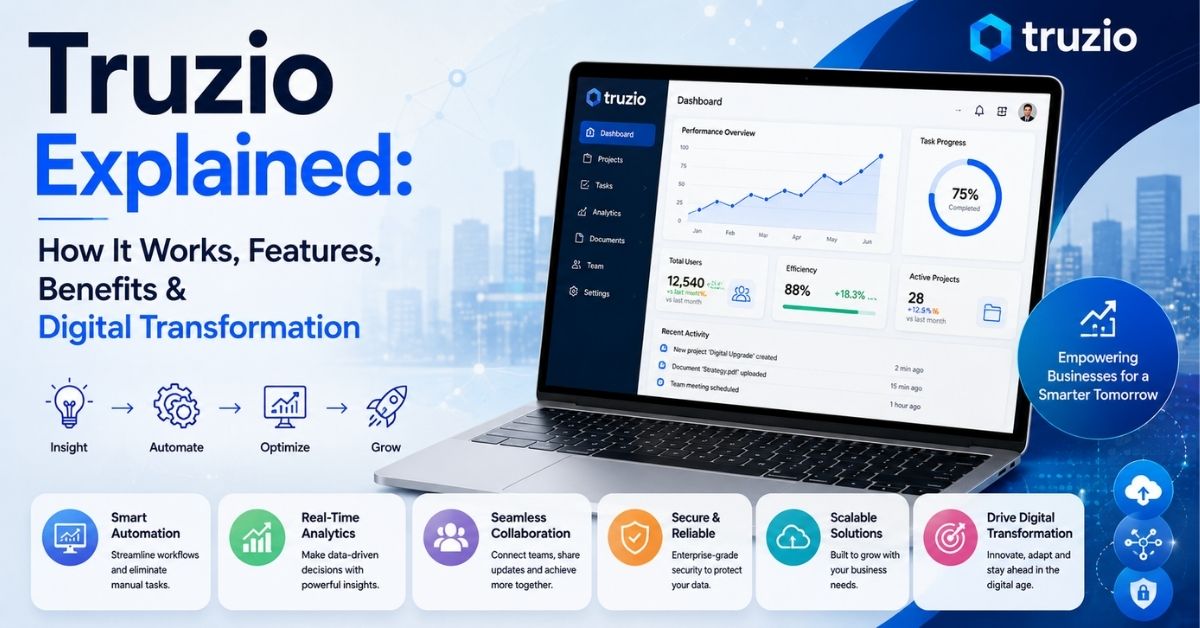
Truzio Explained: How It Works, Features, Benefits & Digital Transformation
Running a business in 2026 means dealing with fast-moving markets and impatient customers. Old software just can’t keep up anymore. That’s why more companies now look at smart business solutions built around one idea: connect everything, automate the boring parts, and make decisions faster.
Truzio is a useful example of this shift. Think of it as a model for a digital transformation platform that pulls data, automation, and analytics into one working system. In this guide, you’ll learn what a Truzio platform does, how Truzio technology works under the hood, and why Truzio solutions matter for companies across the USA. We’ll walk through the architecture, the features, the benefits, and the real challenges too. No fluff. Just a clear, practical breakdown.
What Is Truzio? Definition, Purpose & Core Concept
A digital transformation platform brings scattered tools into one place. Instead of jumping between five different apps, your team works from a single screen. A Truzio business platform follows this same logic. It acts less like a single app and more like connective tissue for your whole company, linking your CRM, your accounting software, and your operations tools without ripping any of them out.
This matters more than it sounds. Most companies don’t fail at digital transformation because they lack tools. They fail because those tools don’t talk to each other. A Truzio digital transformation approach solves that specific problem. It doesn’t replace what you already have. It connects it. And once everything’s connected, your business starts to feel less like a pile of separate departments and more like one coordinated system.
Truzio Definition and Core Purpose
In plain English, Truzio describes a digital business solution that unifies operations, automates repetitive tasks, and turns raw numbers into insight you can actually use. Picture it as a central nervous system. Every department sends signals in. The system sends instructions back out. That’s the whole idea, really. The core purpose stays simple even when the technology behind it gets complex: make the business run smoother, with less manual grunt work and fewer blind spots.
What Truzio Explained and Is Not
Let’s clear up some confusion early, because this trips people up a lot. A Truzio platform is not just a CRM with a new coat of paint. It’s not a fancy dashboard either. And it’s definitely not just an analytics tool bolted onto old software. Each of those tools does one job, and does it fine. But Truzio capabilities work differently. They combine pieces of CRM, analytics, and workflow automation into a single, layered system that’s bigger than any one piece alone.
How Truzio Supports Modern Businesses
Modern businesses juggle a lot at once. Sales runs one tool. Finance runs another. Customer support runs a third. That creates silos, and silos slow everyone down. A Truzio business platform aims to close those gaps by pulling information into one shared, connected system. For companies across the USA, this matters even more right now. Labor costs keep climbing. Customers expect faster answers. A smart business platform helps teams get more done with the staff they already have, instead of hiring their way out of every bottleneck.
How Does Truzio Work Understanding Its Core Architecture
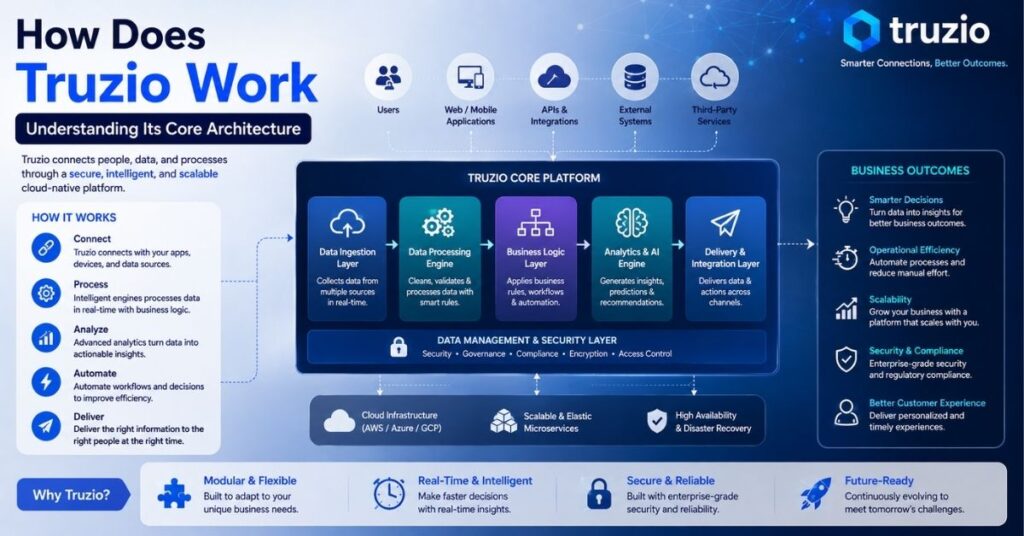
Every solid digital transformation platform needs real structure underneath it. Truzio architecture follows a layered model. Each layer does one specific job. This keeps the whole system organized, instead of turning into another tangled mess of features nobody fully understands.
Here’s how the four layers break down, along with what each one actually delivers for the business:
| Layer | Function | Business Impact |
| Data Layer | Collects and organizes information | Clean, reliable data flow |
| Process Layer | Automates daily workflows | Faster day-to-day operations |
| Intelligence Layer | Applies artificial intelligence and analytics | Smarter, faster decisions |
| Integration Layer | Connects outside systems | One unified, connected ecosystem |
Data Layer: Building the Foundation
The data layer pulls information from ERP systems, CRM platforms, IoT connectivity, and internal databases. It removes duplicate records and closes the gaps between systems that used to ignore each other completely. This creates something close to a single source of truth. Instead of five different numbers describing the same metric, everyone works off one clean, consistent version. Solid centralized data starts right here, at this foundation.
Process Layer: Automating Business Workflows
This is where workflow automation takes over the repetitive stuff. Invoice processing, customer onboarding, inventory updates. All of it runs without someone clicking through the same five screens every single day. Here’s a simple example. A customer places an order online. The system checks stock, updates inventory, and kicks off delivery automatically. Nobody has to retype that order into three different systems by hand.
Intelligence Layer: Supporting Better Decisions
The intelligence layer uses artificial intelligence and predictive analytics to look ahead, not just backward. It can flag operational risks early, forecast customer behavior, and suggest the next best move based on real patterns hiding in the data. This layer is what turns a reactive business into a proactive one. Instead of finding out about a problem after it costs you money, you often see it coming and can act before it does any damage.
Integration Layer: Connecting Business Systems
The integration layer relies on APIs to connect outside tools and platforms. This is real enterprise integration, and it stops data from getting trapped in silos across departments. Teams that used to email spreadsheets back and forth suddenly work off the same live numbers instead. That alone removes a surprising amount of daily friction. As one operations lead might put it in a typical scenario like this: “We stopped reacting to problems and started seeing them coming.” That shift sums up what good system integration is really for.
Key Features and Capabilities of Truzio
Once the architecture is in place, the real value shows up in daily use. Truzio features cover everything from business process automation to customer experience work, all functioning together instead of sitting in separate corners of the business.
These Truzio capabilities give teams practical tools they can put to work right away, not just theoretical potential sitting on a shelf.
Business Process Automation
Business process automation cuts down on manual work across every department. Companies that fully commit to this kind of automation often see meaningfully faster process times, though exact results always vary by company, industry, and how well the rollout was planned.
Real-Time Analytics and Business Insights
Real-time analytics dashboards track sales performance, operational efficiency, and customer engagement as events happen live. This replaces the old habit of waiting for a monthly report that’s already stale by the time it lands in your inbox. Real-time business insights change how fast a team can actually respond.
Cloud-Based Scalability
Cloud computing lets a business handle busy seasons without scrambling for extra servers at the last minute. This kind of scalability matters most during peak demand, like holiday shopping rushes or a big product launch. Scalable technology solutions mean growth doesn’t require a full infrastructure rebuild every time.
Customer Experience Optimization
Customer experience improves when a system tracks behavior and personalizes what each person sees. Recommendations, communication, and support responses all become more relevant, instead of generic and one-size-fits-all.
Enterprise System Integration
Enterprise integration connects legacy systems with newer tools, instead of forcing a full, painful replacement. This saves money. It also avoids the risky process of ripping out everything a company already depends on just to add one new feature.
What Technologies Power Truzio-Style Digital Transformation?
Behind any real Truzio digital transformation effort sits a stack of actual technologies working together. None of these tools accomplish much alone. Combined, though, they create something far more useful than any single piece could manage by itself.
Understanding this digital infrastructure helps explain why the approach works the way it does, instead of treating it like some kind of mysterious black box.
Artificial Intelligence and Machine Learning
Artificial intelligence and machine learning handle demand forecasting, workflow optimization, and inefficiency detection. These systems learn from patterns over time, getting sharper the longer they run and the more data they see.
Cloud Computing and Infrastructure
Cloud infrastructure adds flexibility that on-site servers simply can’t match. Remote access, lower maintenance costs, and easier scaling all come bundled together with a solid cloud setup.
See Also: Adswynk Com: Complete Guide to Features, Earnings, Safety & How It Works
Internet of Things (IoT) Connectivity
IoT connectivity brings real-time tracking to places like manufacturing floors, delivery trucks, and energy systems. Sensors feed live data back into the platform, giving managers visibility they simply didn’t have a few years ago.
Cybersecurity and Data Protection
Cybersecurity and data protection guard everything running underneath the surface. Encryption, identity management, and threat detection work together to keep sensitive information locked down and out of the wrong hands.
What Are the Benefits of Truzio for Businesses?
Every layer and feature eventually points toward one goal: real Truzio benefits that show up in daily operations, not just in a sales pitch. Here’s a closer look at what companies typically notice after adopting an approach built this way.
The table below breaks down where these gains usually show up first.
| Benefit Area | What Changes |
| Operational Efficiency | Fewer manual errors, smoother coordination |
| Decision-Making | Faster awareness, quicker action |
| Cost | Lower labor strain, time redirected to higher-value work |
| Customer Experience | Faster responses, stronger loyalty |
| Agility | Easier pivots when the market shifts |
Improved Operational Efficiency
Operational efficiency improves as manual errors drop and coordination between teams gets smoother. Work simply flows better when everyone pulls from the same information source.
Faster Data-Driven Decision-Making
Data-driven decisions and live dashboards shrink the gap between a problem happening and someone actually noticing it. Faster awareness leads to faster action, every single time.
Reduced Operating Costs
Cost reduction follows naturally once automation absorbs tasks that used to eat up staff hours. That freed-up time gets redirected toward work that actually needs a human brain.
Better Customer Experiences
Customers get faster responses and more personal service. That kind of customer experience improvement often turns into stronger loyalty over the long run.
Greater Agility and Scalability
Companies can pivot faster when the market shifts without warning. This kind of business agility gives leadership more room to adapt without a full operational overhaul every time something changes.
How Can Truzio Be Used Across Different Industries?
Truzio use cases aren’t limited to one type of business. The same core architecture adapts well across very different industries, each with its own specific needs and pressure points.
Let’s walk through a few examples of how this plays out in the real world.
Truzio-Style Solutions in Healthcare
Healthcare teams use systems like this for patient record automation, appointment optimization, and predictive diagnostics. Better data management here can mean faster, more informed care decisions when it matters most.
See Also: Droven Io Best Tech Tools: Complete Guide for Developers In 2026
Truzio-Style Solutions in Financial Services
Financial institutions lean on this kind of setup for fraud detection, risk analysis, and automated compliance tracking. This reduces the manual review work that used to fall on large teams of analysts.
Truzio-Style Solutions in Retail and E-Commerce
Retailers use it for personalized recommendations, inventory prediction, and customer segmentation. This blend of business intelligence and automation helps prevent both overstock and empty shelves.
Truzio-Style Solutions in Manufacturing
Manufacturers apply this technology to predictive maintenance, smart factory tracking, and production monitoring. Catching equipment issues early avoids costly, unplanned downtime on the floor.
Truzio-Style Solutions in Logistics and Supply Chain
Logistics companies rely on route optimization, shipment tracking, and full supply chain visibility. These tools turn what used to be guesswork into something far more predictable and plannable.
How to Implement a Truzio-Style Digital Transformation Strategy
Rolling out a digital transformation strategy takes more than flipping a switch. A phased, thoughtful approach tends to work far better than trying to change everything overnight and hoping for the best.
The steps below cover what most successful rollouts have in common.
Start With Clear Business Goals
Define measurable outcomes before you touch a single system. Vague goals lead to vague results, and that wastes both time and budget you can’t easily get back.
Prioritize High-Impact Processes
Don’t try to transform every department at once. Pick the area causing the most pain first, fix it, and let that early win build momentum for everything that follows.
Prepare and Train Employees
Training isn’t optional here. It’s often the real difference between a tool people actually use and one that quietly gets ignored a few weeks after launch day.
Integrate Existing Systems Carefully
Sequence your legacy systems integration carefully to avoid unnecessary disruption. Rushing this step tends to cause more problems than it ever solves.
Monitor Results and Optimize Continuously
Track business process optimization metrics like process speed, cost savings, and user adoption on an ongoing basis. Numbers drift over time, and catching that early saves headaches down the road.
What Challenges Should Businesses Consider Before Adopting Truzio?
No platform, no matter how well built, comes without friction. Knowing these challenges upfront helps teams plan around them, instead of getting blindsided halfway through a rollout.
Here’s what tends to come up most often in real-world technology adoption.
Legacy Systems and Compatibility Issues
Old systems slow down integration timelines and quietly build technical debt along the way. This is often the single biggest source of delay in any rollout, so plan for it early.
Employee Resistance to Change
People resist new tools, especially without proper training or a clear explanation of why the change matters to their day-to-day work. Change management deserves just as much attention as the technology itself.
Data Privacy and Security Risks
More connected systems mean more potential entry points for security threats. Every new integration is one more door that needs a proper lock on it.
Implementation Costs and Complexity
Upfront investment can feel steep, especially for smaller companies watching every dollar. Weighing that cost against the long-term payoff matters a lot before you commit to anything.
Data Quality and Infrastructure Requirements
The system depends heavily on the quality of the data feeding into it. Poor data in means poor insight out, no matter how advanced the platform looks on paper. Stable digital infrastructure and reliable uptime matter just as much.
Truzio Security, Privacy and Governance Considerations
Truzio security sits at the center of any serious enterprise software deployment. It’s not something bolted on after launch. It has to get built in from day one, or it never really works right.
Strong technology governance backs all of this up, making sure rules around data access actually get enforced, rather than just written down somewhere and forgotten.
Data Security and Access Controls
Data protection relies on encryption and tight access controls paired with identity management. Only the right people should ever see sensitive information, and that access needs regular review, not a one-time setup.
Privacy and Compliance Considerations
US businesses need to think carefully about compliance obligations tied to their specific industry. Healthcare and finance, in particular, carry extra regulatory weight that’s worth planning for early rather than scrambling later.
Cybersecurity Risk Management
Cybersecurity risk management means active threat detection paired with a clear incident response plan. Waiting until something goes wrong is far too late to start figuring out what to do.
Governance, Monitoring and Accountability
Ongoing technology governance keeps data accurate and access appropriate as the business grows. This isn’t a one-time setup step. It needs regular attention, year after year.
⭐ How to Evaluate Truzio Before Choosing a Digital Transformation Platform
Picking any enterprise technology solution deserves real scrutiny, not a quick decision based on a slick demo. It helps to compare features side by side against what your business actually needs day to day.
Below is a simple framework to guide that evaluation.
| Evaluation Area | What to Check |
| Features | Automation depth, AI capability, reporting tools |
| Integration | Compatibility with current legacy systems |
| Scalability | Can it grow with the business without a rebuild |
| Total Cost of Ownership | Licensing, training, migration, ongoing maintenance |
Features to Compare With Alternative Platforms
Compare automation depth, reporting quality, and how well each option handles enterprise integration. Not every platform automates the same processes equally well.
Integration, Scalability and Total Cost of Ownership
Look past the sticker price. Factor in training time, migration effort, and long-term maintenance. A cheaper tool that fights your existing systems can cost more in the end.
See Also: Bobbilou05 in the Digital World: Meaning, Identity & Online Influence in 2026
Questions to Ask Before Adoption
Ask how the platform handles your specific industry’s compliance needs. Ask how long a typical rollout takes. Ask what support looks like after the contract gets signed, not just before.
Is Truzio Right for Your Organization?
Not every company needs the full weight of an enterprise digital transformation platform right away. It helps to ask a few honest questions before committing any budget to it.
Answering these honestly can save a lot of wasted time and money down the road.
When Truzio-Style Solutions Make Sense
These systems make the most sense when disconnected tools and heavy manual work are already slowing your team down. If your reports feel outdated the moment you read them, that’s usually a strong signal too.
Businesses That May Benefit Most
Mid-size to enterprise companies running multiple departments and systems tend to see the biggest gains. Smaller, simpler operations may not need the full scope right away.
When a Different Solution May Be Better
A smaller, lighter tool might make more sense if your operation is simple, your data volume is low, or your budget genuinely can’t stretch to a full platform yet.
⭐ Truzio vs Traditional Business Systems: What Changes?
The shift from traditional business systems to a connected model changes more than just the software. It changes how decisions actually get made across the company, day to day.
Here’s a direct comparison of the two approaches.
| Traditional Systems | Truzio-Style Approach |
| Manual workflows | Automated workflows |
| Siloed information | Centralized data |
| Delayed reporting | Real-time analytics |
Automation vs Manual Workflows
Manual processes eat up hours that automation can handle in minutes. That time adds up fast across a whole team, week after week.
Centralized Data vs Siloed Information
Siloed data creates conflicting numbers between departments. Centralized data gives everyone the same accurate picture, all the time.
Real-Time Insights vs Delayed Reporting
Delayed reporting means decisions get made on stale information. Real-time analytics close that gap and speed up the entire decision cycle.
Digital Transformation Trends Shaping Truzio in 2026
Broader industry shifts continue to shape how Truzio digital transformation approaches evolve. Staying aware of these trends helps businesses plan ahead, instead of constantly playing catch-up with competitors.
Here are the trends worth watching most closely through the rest of 2026.
AI-Driven Business Operations
AI-powered operations now handle core decisions in plenty of companies, not just experimental pilot programs anymore. This shift keeps accelerating as the technology matures.
Hyperautomation and Intelligent Workflows
Intelligent workflows blend AI, robotic process automation, and analytics into one continuous layer. This goes well beyond simple task automation alone.
Low-Code and No-Code Development
Low-code tools let teams build applications faster, without needing deep coding expertise on staff. This speeds up development timelines considerably across the business.
Real-Time Data and Predictive Analytics
Predictive analytics and real-time data have mostly replaced the older reporting cycles that left teams working off stale numbers for weeks at a time.
⭐ What Does the Future of Smart Business Platforms Look Like?
Looking past the current moment, next-generation platforms appear headed toward even deeper intelligent automation. The pace of change here shows no real sign of slowing down anytime soon.
These shifts will likely reshape how companies think about technology altogether, not just how they use it day to day.
More Intelligent Automation
Expect more autonomous systems that don’t just suggest actions but start taking some of them directly, with appropriate human oversight built in.
Connected and Data-Driven Operations
Data-driven operations will likely deepen further, with systems pulling from even more sources across the business over time.
AI-Powered Decision Support
Predictive intelligence will likely move beyond simple dashboards, offering more specific and actionable guidance for teams making real decisions.
Stronger Security and Governance
As automation grows, security and governance will need to mature right alongside it, not lag behind as an afterthought nobody budgeted for.
Frequently Asked Questions
What Is Truzio?
Truzio describes a digital transformation platform that connects business data, automation, and analytics into one unified system, helping companies replace scattered tools with a single, connected approach.
What Does Truzio Do for Businesses?
It automates repetitive tasks, organizes data into a single source of truth, and gives teams real-time business insights they can act on right away.
How Does Truzio Work?
It works through a layered architecture covering data, process automation, intelligence, and system integration, all functioning together as one connected platform.
What Are the Main Benefits of Truzio?
Key benefits include improved operational efficiency, faster decision-making, reduced operating costs, and stronger customer experiences across the business.
What Industries Can Use Truzio-Style Solutions?
Healthcare, financial services, retail, manufacturing, and logistics all commonly use systems like this, though the underlying approach can apply to almost any data-heavy industry.
Conclusion
Truzio, as a model, represents a broader shift happening across modern business technology. Companies are moving away from fragmented tools and toward connected business systems that actually talk to each other, instead of working in isolation.
This isn’t just about digitizing old processes for the sake of it. It’s about rethinking how decisions get made in the first place. In 2026, speed, clarity, and smart automation separate the businesses pulling ahead from the ones stuck playing catch-up. Whatever platform you eventually choose, using this framework to evaluate it will help you build a genuinely future-ready business.

Daniel Brooks is a language and slang writer at MeaningZen, passionate about explaining modern words, phrases, and internet slang in simple, easy-to-understand language.