
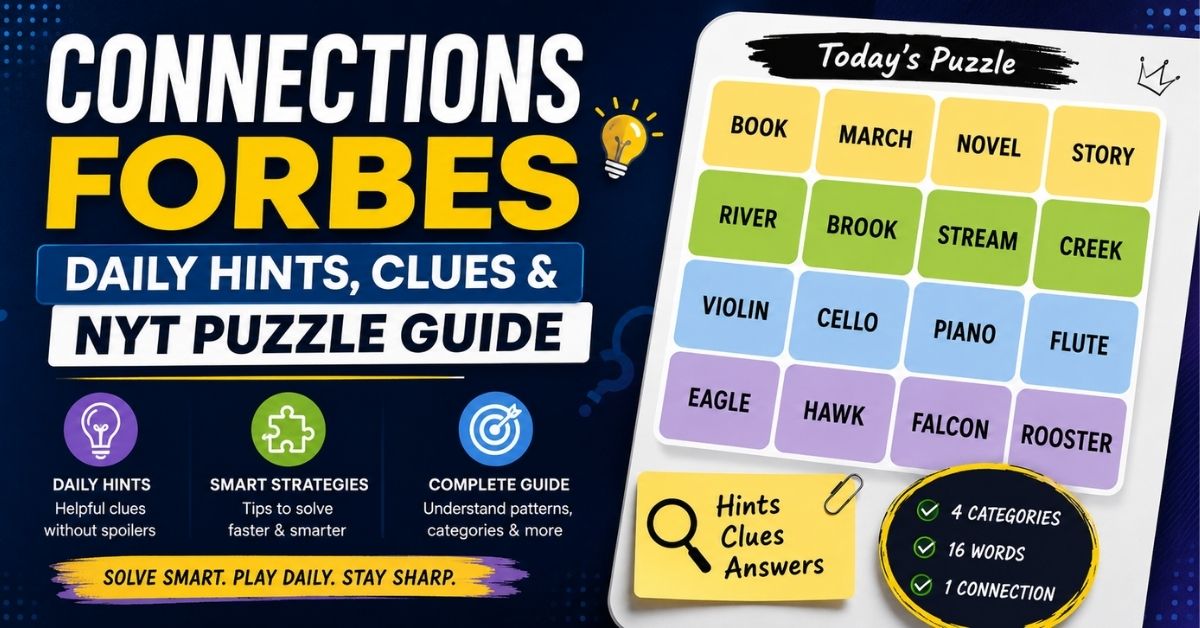
Connections Forbes: 2026 Best Hints & Clues Guide
You open your phone. You see sixteen words in a grid. You have no idea where to start. That’s the moment most people search for Connections Forbes hints. This guide walks you through what that search term means, how the puzzle works, and how to get just enough help without ruining the fun.
We’ll cover the full picture here. You’ll learn how Connections Forbes today hint pages are built, what each difficulty color means, and how to actually get faster at solving. No fluff, just the stuff that helps.
What Is Connections Forbes?
Connections Forbes is the name people use for Forbes’ daily hint articles about the New York Times word puzzle. It’s not a separate game. Forbes doesn’t own or build the puzzle. Instead, Forbes publishes daily Connections Forbes hints, Connections Forbes clues, and eventually Connections Forbes answers, laid out in stages so readers can stop reading whenever they’ve got enough help.
This staged approach is why the phrase shows up in search bars every single morning. People don’t always want the full answer right away. They want a nudge. A good spoiler-free hints page respects that, and it’s the reason Forbes Connections hints pages get bookmarked and revisited daily.
What Is the NYT Connections Game?
NYT Connections is a daily word puzzle made by New York Times Games, the same team behind Wordle and Spelling Bee. It launched in 2023 and quickly became part of the daily routine for millions of players across the New York Times puzzle lineup. Every single day brings a brand new daily Connections puzzle, so there’s always something fresh to try.
Unlike a crossword, Connections isn’t about defining words. It’s about spotting a common relationship between them. You’re not writing anything down. You’re just grouping.
How the Daily Puzzle Works
Every Connections puzzle follows the exact same shape. There are always 16 words. You sort them into four groups, with four words each. You get four mistakes before the puzzle locks you out. That’s it. Simple rules, tricky execution.
| Feature | Detail |
| Total words | 16 words |
| Groups | Four groups |
| Words per group | Four words |
| Mistakes allowed | 4 |
| New puzzle | Every day |
The Four Word Groups Explained
Each of the four groups in a four-by-four word grid gets a color once solved: yellow, green, blue, or purple. These colors aren’t random. They mark the difficulty level of that particular word grouping, from the easiest category to the hardest. We’ll break each one down further in a later section.
How Connections Forbes Hints Work
A good Connections Forbes article doesn’t dump the answer on you right away. It builds in layers. First comes a general mood-setter something like “today’s purple category is unusually sneaky.” Then comes a category clue. Then the category name itself. Only at the very end do you get the complete solutions.
This layered structure matters more than it seems. It lets you choose your own hint strategy. Maybe you only need the first layer. Maybe you’re stuck and need the whole puzzle walkthrough. Either way, the format gives you solving assistance without forcing a full spoiler on you.
See Also: Erikkapost com: Features, Content, Safety & How It Works in 2026
General Hints Without Spoilers
A general difficulty hint might say the yellow category is unusually tricky today, or that the purple group involves wordplay. These gentle hints don’t name anything. They just prepare you mentally, the way a weather forecast preps you for rain without telling you exactly when the first drop falls.
Category Names and Clues
If the general hint isn’t enough, the next layer reveals a category clue or the category names themselves something like “Things Found in a Kitchen.” Seeing the actual category often unlocks the whole grid at once, since your brain can now hunt for a specific match instead of guessing blind.
Complete Answers and Word Groups
This is the answer reveal the full grid, every Connections word groups listed out. Use this section to check your work after solving, or as a last resort when you’re genuinely stuck and ready for the complete solution.
Puzzle Analysis and Explanations
The best hint pages don’t stop at the answer. They explain the answer explanation behind each grouping why those four words belong together, what the puzzle designer was thinking. This is where real learning happens, and it’s what separates a shallow hint page from one that actually makes you better.
Why People Search for Connections Forbes Today
People search NYT Connections today for a mix of reasons. Some are protecting a solving streak and don’t want to break it over one stubborn purple square. Others hit a category built on cultural references or pop culture references they just don’t recognize. And some simply want confirmation before locking in a guess, since every wrong answer counts against that four-mistake limit.
The habit runs deeper than convenience, though. For a lot of Americans, this daily challenge is baked into the morning right alongside coffee and the news. That daily rhythm is exactly why Connections Forbes hints trend every morning without fail.
How to Use Connections Forbes Hints Without Spoilers
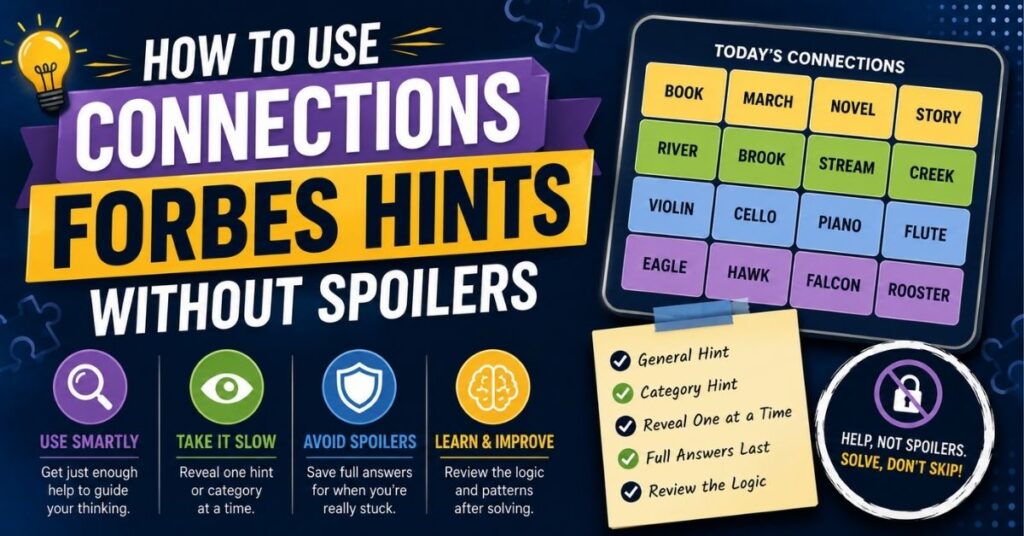
Using hints well is a skill of its own. The goal isn’t to avoid help entirely. It’s to take only as much as you need, so you keep the independent solving experience alive.
Here’s how the process breaks down step by step.
Start With the General Hint
Read the overview first. It sets expectations. If today’s puzzle skews hard, you’ll approach it slower and more carefully instead of rushing in.
Reveal One Category at a Time
Don’t scroll straight to the bottom. Uncover one category reveal at a time, and go back to the puzzle between each one. This keeps the challenge alive instead of turning it into a copy-paste exercise.
Save the Answers for Last
Treat the full Connections puzzle answers as your emergency exit, not your first stop. You’ll remember far more if you struggle a little first.
Check the Logic After Solving
Once you’ve finished, read the explanation anyway. Understanding the puzzle designer‘s logic trains your brain to spot similar patterns tomorrow.
See Also: Unbanned G: Complete Guide to Unblocked Gaming, Safety & How It Works
NYT Connections Difficulty Levels Explained
Every puzzle uses the same four-color system to signal Connections difficulty. Once you understand what each Connections colors tier usually contains, you can guess where to start before you’ve even read a single hint.
| Color | Difficulty Level | Typical Theme |
| Yellow | Easiest category | Direct, obvious groupings |
| Green | Moderate category | Slightly indirect links |
| Blue | Difficult category | Ambiguous, multiple meanings |
| Purple | Hardest category | Wordplay, hidden meanings |
Yellow: The Easiest Category
Yellow category groupings are usually straightforward think colors, animals, or months. This is almost always the best place to start, since it builds momentum fast.
Green: A Moderately Easy Connection
Green Connections groups need a touch more thought. They might involve professions or household items, connections that are real but not instantly obvious.
Blue: A Challenging Word Relationship
Blue category groupings usually hide an ambiguous relationship. A word might seem to fit two different groups at once, so careful analysis matters here more than instinct.
Purple: The Hardest and Most Creative Category
Purple Connections is where the puzzle designer gets creative. Expect puns, homophones, shared prefixes or suffixes, and sometimes rhyming words. This tier is what separates casual players from daily regulars.
Common Types of NYT Connections Categories
Recurring patterns show up across the Connections categories you’ll see week to week. Learning to recognize them speeds up your solving time dramatically, because you’ll stop treating every puzzle as a brand-new mystery.
Some categories lean on straightforward meaning, while others hide behind sound or structure instead of definition.
Synonyms and Related Words
These groupings rely on words that mean roughly the same thing, like “Happy,” “Glad,” and “Joyful.” They’re usually the easiest to spot on sight.
Wordplay and Double Meanings
These categories thrive on multiple meanings. A word like “Bark,” “Pitch,” or “Match” could belong to several different groups, which is exactly the trap the puzzle wants you to fall into.
Proper Nouns and Names
Company names, celebrities, and places show up more often than people expect. Don’t assume every word on the grid is a common noun.
Phrases and Common Expressions
Some groupings connect words that all pair with the same phrase or expression, even though the words themselves look unrelated at first glance.
How to Solve NYT Connections Faster
Fast solvers rarely guess at random. They follow a repeatable process built on logical deduction and pattern recognition, and you can copy that process yourself.
The steps below work in almost any order, but doing them roughly in sequence tends to save the most time.
Find the Most Obvious Group First
Locking in the easiest obvious connections first clears mental clutter and shrinks the puzzle down to something more manageable.
Look for Multiple Meanings
Watch for words carrying alternate meanings. These are usually the key to unlocking the trickier groups.
Watch for Red Herrings
Puzzle makers plant red herrings on purpose. Four words might look related while actually belonging to four separate groups, so don’t lock in your first guess too fast.
See Also: Wall Post Media com: Complete Guide to Features, Pricing & How It Works
Rearrange and Compare the Words
Scanning the grid in rows only gets you so far. Try comparing words diagonally or out of order. Fresh angles reveal connections your eyes skipped the first time.
Eliminate Weak Connections
Cross out combinations that clearly don’t work. This kind of eliminate possibilities approach narrows your options fast, even when you’re not sure of the right answer yet.
Save Unusual Words for Last
Rare or unfamiliar words almost always belong to the hardest group. Don’t waste early time trying to force them into an easy category.
Common NYT Connections Mistakes to Avoid
Even longtime players fall into the same traps again and again. Knowing them ahead of time helps you dodge wasted guesses.
Most mistakes come down to moving too fast or trusting your first instinct too much.
Rushing Into an Obvious Group
Some groupings are built to look identical to another category. Pause before you submit, even when you feel certain.
Ignoring Alternate Meanings
The first definition that comes to mind isn’t always the right one. Stay open to a second reading of each word.
Overlooking Wordplay
Purple groups especially reward lateral thinking over literal interpretation. Taking a word at face value often leads straight into a trap.
Forgetting Proper Nouns
Proper nouns sneak into grids more than people expect. Keep names, brands, and places on your radar the whole time.
Guessing Too Early
You only get four mistakes. Avoid random guessing and treat every submission like it actually counts, because it does.
Benefits of Playing NYT Connections Daily
This isn’t just a way to kill five minutes. Playing a daily word puzzle consistently builds real mental skills over time, and the payoff shows up in ways beyond the game itself.
Three benefits stand out the most among regular players.
Vocabulary and Word Recognition
Regular play sharpens vocabulary recognition, since you’re constantly weighing definitions and word relationships against each other.
Critical Thinking and Pattern Recognition
Critical thinking and pattern recognition both get a workout here. You’re trained to look past the obvious and search for hidden structure.
Problem-Solving Skills
General problem-solving skills improve too, along with memory recall, since good solvers remember which combinations they’ve already ruled out.
Where to Find Daily Connections Hints and Answers
Connections Forbes isn’t the only place to find help. Several sources cover the puzzle daily, and each one takes a slightly different approach to how much they reveal and how fast.
| Source | What You’ll Find |
| New York Times Games | The official puzzle itself |
| Forbes | Staged daily hints and answer explanations |
| Reddit communities | Player discussion and debate |
| Puzzle blogs | Alternative strategies and breakdowns |
| YouTube | Full video walkthroughs |
How to Search for Connections Hints Without Spoilers
A few small habits protect you from accidental spoilers. Search using the word “hint” instead of “answer,” and stop reading the moment you’ve got enough to continue. Avoid thumbnail previews that show a solved grid, and skip comment sections until after you’ve finished.
These tiny adjustments keep the spoiler protection intact, so you get to experience the reveal yourself instead of having it handed to you by accident.
Frequently Asked Questions
What Does Connections Forbes Mean?
It refers to Forbes’ daily hint and answer articles covering the NYT Connections puzzle.
Does Forbes Create the NYT Connections Puzzle?
No. New York Times Games builds and owns the puzzle. Forbes only provides independent hint coverage.
Are Connections Forbes Hints Spoiler-Free?
Mostly, yes, at least in the early stages. The pages start spoiler-free and only reveal full answers toward the end.
What Do the Yellow, Green, Blue, and Purple Colors Mean?
They represent difficulty level, moving from easiest category to hardest category in that order.
Where Can I Play NYT Connections?
You can play through the official New York Times Games website or the NYT Games app.
Can I Play Older Connections Puzzles?
Yes, though access to the archive depends on your New York Times subscription.
Should Beginners Use Connections Hints?
Absolutely. Hints teach puzzle-solving strategies without stripping away the whole challenge, which makes them a genuinely useful learning tool rather than a shortcut.
Final Thoughts
Connections Forbes has turned into a daily stop for players who want just enough help to keep going, without losing the reward of solving it themselves. The staged format, from a general difficulty hint all the way to the complete solution, gives you control over exactly how much help you take.
The real value isn’t finishing today’s grid. It’s building pattern recognition and logical reasoning you’ll carry into tomorrow’s puzzle. Use hints when you need them, read the explanation afterward, and each new Connections puzzle gets a little less intimidating than the last.

Ryan Mitchell is a writer and language enthusiast at MeaningZen. He creates simple guides on slang, word meanings, grammar, and modern internet language. His goal is to make confusing words and phrases easy to understand.