
CNLaw Blog 2026: Complete Guide to Legal Content, Trust & Safety
Legal research used to mean law libraries and thick books. Now, most people start with a search bar. If you’ve searched for Chinese law online, you’ve probably landed on CNLawBlog. And you’ve probably asked yourself: is this site actually worth reading?
This guide answers that question in full. We’ll look at what CNLawBlog is, how it works, who runs it, and whether you can trust it. We’ll also cover CNLawBlog legitimacy, CNLawBlog safety, and where it fits next to other Chinese legal resources. By the end, you’ll know exactly when to use it and when to call a lawyer instead.
What Is CNLawBlog?
CNLawBlog is a Chinese law blog written in English. It explains China’s legal system for readers who don’t speak Mandarin and don’t have a law degree. Think of it as a translator, not a translator of language exactly, but a translator of complexity. It takes dense Chinese legislation and turns it into something a business owner can actually read on a lunch break.
It doesn’t practice law, and it doesn’t take clients. It’s an online legal resource, plain and simple. The site publishes articles, guides, and a few interactive tools, and it does this for free. That alone sets it apart from paid legal research platforms that charge steep subscription fees for similar information.
What Does CNLawBlog Cover?
The content spans several major areas of China business law. You’ll find articles on company registration, employment rules, data protection, and intellectual property. There’s also coverage of trade compliance and newer topics like AI governance, which most competing sites barely touch.
| Topic Area | Example Subtopics |
| Corporate & Business Law | WFOE setup, joint ventures, SAMR filings |
| Data Privacy | PIPL, cross-border data transfer, CAC rules |
| Intellectual Property | CNIPA trademarks, patents, trade secrets |
| Trade & Compliance | Export controls, tariffs, WTO disputes |
Who Is CNLaw Blog For?
The site is built for a global crowd, not just American readers. Entrepreneurs in Europe, Australia, and Southeast Asia use it just as often as US founders do. Law students studying comparative law lean on it too, since it breaks down foreign legal concepts without the usual academic jargon.
Compliance officers at multinational companies also check it regularly. It works well as a quick regulatory news feed. Journalists covering trade stories use it for background context before they call an actual source. In short, if you need China legal information fast and in plain English, you’re the target reader.
What Legal Topics Does CNLawBlog Cover?
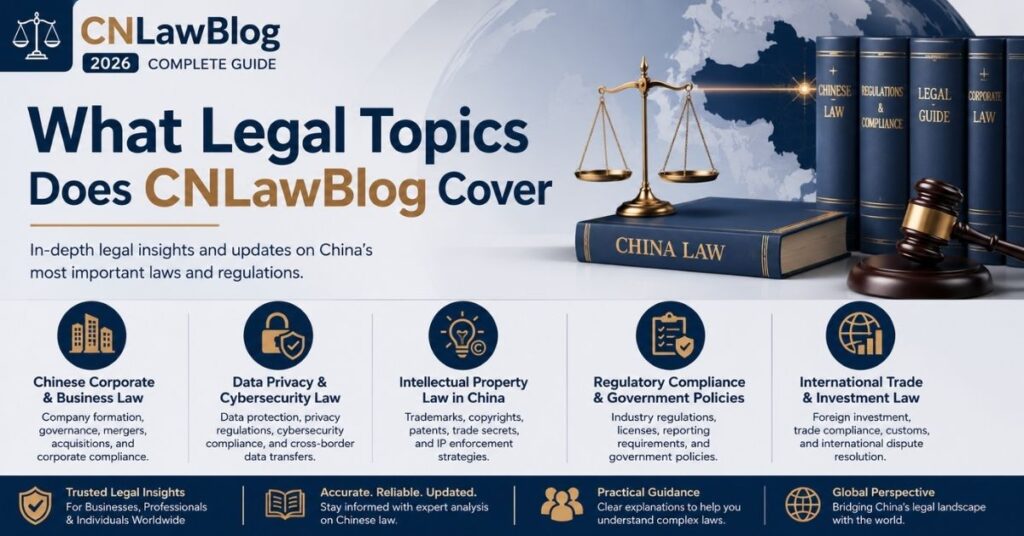
CNLawBlog doesn’t stick to one narrow lane. It covers a wide slice of the Chinese legal system, which is part of why it attracts such a mixed audience. Some readers come for business setup guidance. Others come purely for the data privacy content, since PIPL has become a major compliance headache worldwide.
This breadth is a strength and a small weakness at once. Wide coverage means something for almost everyone, but it also means individual topics don’t always get the depth a specialist site might offer. Still, for a free platform, the range of legal articles here is genuinely impressive.
Chinese Corporate and Business Law
This section covers the practical side of entering the Chinese market. It walks through WFOE incorporation step by step, including registered capital rules and SAMR filing requirements. It also explains joint venture structures and why some industries still require a local partner under Chinese corporate law.
For a founder who’s never dealt with Chinese bureaucracy before, this is genuinely useful groundwork. It won’t replace a lawyer’s filing work, but it will help you walk into that first consultation already understanding the basic vocabulary.
Data Privacy and Cybersecurity Law
PIPL, China’s Personal Information Protection Law, took effect in 2021 and changed how companies handle Chinese user data. CNLawBlog breaks down how PIPL compares to Europe’s GDPR, and it explains cross-border data transfer rules in terms a non-lawyer can follow.
CNLaw Blog 2026 The site also covers the Data Security Law and the Cybersecurity Law, both enforced by the Cyberspace Administration of China. Getting this wrong isn’t a small mistake. Fines can be steep, and in serious cases, companies risk losing market access altogether.
Intellectual Property Law in China
IP theft remains one of the top worries for foreign businesses operating in China. CNLawBlog covers CNIPA trademark filing, patent strategy, and trade secret protection. It also flags a common and costly mistake: waiting too long to register a trademark, which opens the door to trademark squatters.
This section reads like something a founder should skim before their first meeting with an IP attorney. It won’t file your paperwork, but it will help you ask smarter questions when you do hire someone.
See Also: Uploadblog.com: Complete Guide, Features, Content & Updates
Regulatory Compliance and International Trade
Export controls between the US and China have grown more complicated since 2018, and CNLawBlog tracks these changes in accessible language. It covers WTO dispute mechanisms, tariff impacts, and how updated export control lists affect tech companies specifically.
For compliance teams who need to stay current without reading government gazettes daily, this section works as an early warning system. It’s not a substitute for legal monitoring software, but it’s a solid free supplement.
How Does CNLawBlog Work?
Understanding the mechanics behind any legal information website matters before you decide how much weight to give it. CNLawBlog runs like a standard content blog. There’s no paywall, no login requirement, and no client intake form. You read, you learn, you leave.
Alongside articles, the site offers a few interactive tools: a compliance checklist generator, a business setup wizard, and a bilingual legal glossary. These tools are genuinely rare among free Chinese legal resources, and they add real value for readers doing early-stage research.
CNLawBlog’s Content Publishing Model
The site publishes on a fairly consistent schedule, which matters a lot in a field where China legal updates happen constantly. New NPC legislation and CAC enforcement changes can shift the picture within months, so a blog that goes quiet for a year isn’t much use to anyone.
The publishing model leans on written guides rather than video or podcasts. This keeps things simple, but it also means the site depends entirely on text quality and citation habits to build trust. That’s a point we’ll dig into more in the next section.
Legal Education vs. Professional Legal Advice
Here’s the line that matters most. Legal education explains how a law generally works. Legal advice applies that law to your specific situation, with your specific facts, and your specific risk. CNLawBlog does the first. It cannot, and does not claim to, do the second.
An article can explain what a standard employment contract clause means under Chinese labor law. It cannot tell you whether your particular contract, with your particular employee, in your particular city, will hold up in a dispute. That gap is exactly why every article carries a “not legal advice” disclaimer.
See Also: Izonemedia360 com: Free Online Promotion Tools In 2026
Who Runs CNLawBlog? Authors, Editors & Ownership
CNLawBlog ownership is one of the murkier parts of this whole picture. Most established legal blogs proudly list their attorneys by name, along with bar admissions and law school credentials. CNLawBlog doesn’t consistently do this, and that’s worth taking seriously rather than glossing over.
This doesn’t automatically mean the content is wrong. It does mean readers can’t easily verify who’s behind the writing, which limits how much professional weight the site can carry. CNLawBlog editorial team details remain thin compared to competitors like Harris Sliwoski, where named attorneys Dan Harris and Steve Dickinson bring decades of documented experience.
Does CNLawBlog Identify Its Authors and Editorial Team?
Not consistently, no. Some guest contributors are described as legal professionals or compliance consultants, but verifiable bar admissions aren’t listed publicly. This affects CNLawBlog credibility under Google’s E-E-A-T framework, which stands for Experience, Expertise, Authoritativeness, and Trustworthiness.
To be fair, the site does carry consistent legal disclaimers, and it’s active on LinkedIn and other professional platforms, which suggests real editorial investment behind the scenes. But without named CNLawBlog authors, readers are left taking quality on faith rather than on credentials.
Is CNLawBlog Connected to the Chinese Government?
Based on available public information, there’s no verified connection between CNLawBlog and the Chinese Communist Party or any state institution. Anonymous authorship raises credibility questions, but it doesn’t automatically suggest government control. Those are two separate issues, and it’s worth keeping them separate.
If you’re worried about reading state-filtered content, that specific concern doesn’t appear to apply here. The bigger, more grounded concern is simply the lack of named professional accountability, not political influence.
Is CNLawBlog Legit and Trustworthy?
Is CNLawBlog legit? Based on the evidence available, it appears to be a real, functioning, independent blog rather than a scam operation. It publishes consistently, it covers real legal topics accurately in a general sense, and it carries appropriate disclaimers throughout.
That said, “legitimate” and “authoritative” aren’t the same thing. CNLawBlog trustworthiness depends heavily on how the content is used. As a learning tool, it holds up well. As a primary source for a high-stakes legal decision, it falls short of what serious research demands.
Accuracy, Sources and References
The strongest CNLawBlog articles cite specific statutes, things like “PIPL Article 38” or “Chinese Civil Code Article 1043.” That’s a good sign. It shows the writer actually engaged with the underlying law rather than paraphrasing secondhand summaries.
The weaker articles make broader claims without pointing to a specific statute or regulatory body. When you’re evaluating CNLawBlog accuracy, this is the fastest test available. If a claim isn’t backed by a named law or agency, treat it as a starting point, not a finished answer.
Author Transparency and Editorial Signals
We’ve already touched on this, but it deserves its own honest look. CNLawBlog sources and CNLawBlog citations vary in quality article to article, which is common on blogs without a strict editorial review process. Without named legal editors checking each piece, consistency naturally suffers.
This isn’t necessarily unusual for the format. Plenty of independent legal blogs operate this way. It just means readers need to do a bit more verification work themselves, rather than assuming every claim carries professional sign-off.
Domain Reputation and Online Presence
CNLawBlog operates across multiple domain extensions, including .com, .net, .org, and .blog. This multi-domain approach can dilute overall domain authority in search rankings, and it’s a slightly unusual structure for a single content brand.
CNLawBlog domain history appears newer compared to established names like China Law Blog, which has operated since 2006. A newer domain isn’t a red flag by itself, but it does mean the site has had less time to build the kind of long-term trust signals that older platforms enjoy.
What Does Scamadviser Say About CNLawBlog?
Some reports point to a lower-than-average Scamadviser trust score for CNLawBlog. It’s worth being careful here, since we haven’t independently verified this figure firsthand, and automated trust scores can be triggered by fairly mundane factors.
Shared hosting environments, newer domain registration, and thin WHOIS data can all lower a CNLawBlog scam check score without any actual wrongdoing involved. If you’re checking this yourself, we’d recommend running your own live scan rather than relying on secondhand figures, since scores can shift over time.
Is CNLawBlog Safe to Use?
Is CNLawBlog safe? For general reading and research, yes, it appears low-risk. There are no widely reported issues involving malware, phishing, or misinformation campaigns tied to the site. Basic browsing safety here looks comparable to any established content platform.
CNLawBlog security in the technical sense, meaning encryption and standard web protections, appears to follow normal practice. That said, safety online always has two sides: the technical side and the informational side. The second one matters more here.
Website Security and Privacy Considerations
Before entering any personal information on CNLawBlog or a similar site, check for HTTPS encryption, a visible privacy policy, and clear cookie disclosures. CNLawBlog privacy practices should be reviewed the same way you’d review any website before submitting an email address or business details.
None of this is unique to CNLawBlog. It’s simply good practice on any legal information website, especially one where authorship and editorial oversight aren’t fully transparent.
How to Verify Information Before Relying on It
The safest habit is simple: treat every claim as a lead, not a conclusion. Cross-check statute numbers against the actual NPC gazette or official government bulletins. If an article mentions a specific regulation, search for that regulation directly rather than trusting the summary alone.
This single habit solves most of the risk associated with using any free legal information website, CNLawBlog included.
What Are the Strengths and Limitations of CNLawBlog?
Every resource has trade-offs, and CNLawBlog is no exception. Its biggest strength is accessibility. Its biggest weakness is the same thing that limits most free legal blogs: it can’t know your specific situation, and it can’t guarantee it’s current the moment you read it.
Weighing these honestly is the whole point of this guide. Below, we break both sides down so you can decide how much weight to give the content in your own research.
Strengths of CNLawBlog
The site is free, which matters enormously against paid legal research platforms charging thousands per year. It’s also genuinely plain-language, covering complex topics like PIPL or WFOE setup without drowning readers in legal Latin. The interactive tools, particularly the compliance checklist generator, aren’t available on most competing free sites.
Update frequency is another plus. Given how fast China regulations shift, a blog that publishes regularly holds far more value than one that goes stale for months at a time.
Lack of Personalized Legal Guidance
No blog article can account for your specific contract, your specific industry, or your specific dispute. General explanations are exactly that, general. The moment your situation gets specific, you need a person, not a page.
This is the single most important limitation to keep in mind, and it applies to every legal blog, not just this one.
Outdated Laws and Content Verification Risks
Chinese law moves quickly. An article accurate in 2024 might already be outdated by 2026 if new CAC guidance or NPC legislation has shifted the rules. Always check the publication date before treating any article as current.
If an article doesn’t display a clear publication or update date, treat that as its own small warning sign.
⭐ What Information Should You Double-Check Before Acting?
Before acting on anything you read, verify the cited statute number, confirm the regulatory body named in the article still enforces that rule, and check the publication date against recent China legal updates. If numbers like fines or deadlines are mentioned, confirm them against an official source before treating them as fact.
CNLawBlog vs. Established Legal Resources
CNLawBlog occupies a specific lane: free, plain-language, beginner-friendly. It doesn’t try to out-depth professional law firm blogs, and it shouldn’t be judged as if it were trying to. Comparing it fairly means comparing it against what it’s actually built to do.
How CNLawBlog Compares With Official Legal Sources
| Resource | Type | Depth | Cost |
| CNLawBlog | Independent blog | Basic to moderate | Free |
| Harris Sliwoski | Law firm blog | Expert-level | Free |
| China Briefing | Advisory firm | Moderate to deep | Partial |
| NPC Observer | Academic blog | Deep legislative detail | Free |
| Practical Law | Paid database | Comprehensive | Paid |
Government sources remain the most authoritative for official rules. Law firm blogs offer practical, credentialed interpretation. Academic sites like NPC Observer serve researchers needing legislative depth. CNLawBlog sits comfortably as an entry point before any of those.
When Should You Use a Lawyer or Professional Legal Database Instead?
Certain moments call for a licensed professional, full stop. Incorporation decisions, IP litigation, PIPL compliance audits, and employment termination disputes all fall into this category. No amount of good blog writing replaces a lawyer who can review your actual documents and your actual risk.
When Is CNLawBlog Useful And When Is It Not Enough?
Timing and context change everything here. Early research calls for a resource like this. High-stakes decisions do not.
Using CNLawBlog for Legal Research and Education
For CNLawBlog legal content review purposes, or just general legal research before a big decision, the site works well as a first stop. It helps readers identify which legal concepts even apply to their situation before diving into denser official sources.
See Also: SimplifyDiggs.com Review: Features, Insights & Trust Guide 2026
Using It to Understand Legal Terminology and Trends
The bilingual glossary tool is genuinely handy for translating terms like “beneficial ownership” or “data localization” into plain English alongside the Chinese legal terminology. It also works as a way to follow broader trends in Chinese legislation over time.
⭐ Situations Where You Should Not Rely on a Legal Blog Alone
Active litigation, contract signing, compliance audits with real financial exposure, and cross-border FDI structuring are all situations where a blog, any blog, isn’t enough on its own.
Court Proceedings, Contracts and Business Decisions
Court proceedings require case-specific legal strategy that no general article can offer. Contracts require careful clause-by-clause legal review. And major business decisions, especially ones involving real money or real regulatory exposure, deserve professional sign-off before you move forward.
How to Use CNLawBlog Safely and Effectively
Good research habits make any free resource more useful. These next few habits apply specifically to getting real value out of CNLawBlog without getting burned by outdated or unverified claims.
Check the Publication and Update Date
Always look at when an article was published or last updated. In a legal environment this fast-moving, a twelve-month-old article can already be stale.
Compare Claims With Official Legal Sources
Cross-reference anything important against the NPC gazette, MOFCOM bulletins, or SAMR announcements. Independent translation projects like China Law Translate are also useful for double-checking legislative language.
Check Author Credentials and Citations
Look for named contributors where available, and give extra weight to articles that cite specific statutes over ones that make broad, unsupported claims.
⭐ A 5-Step CNLawBlog Verification Checklist
- Check the publication or last-updated date on the article.
- Locate the specific statute or regulation cited, and confirm it still applies.
- Cross-check the claim against an official government source.
- Look for author or contributor information, where available.
- Treat any interactive tool output as a draft, not a final compliance plan.
Who Should Use CNLawBlog?
Fit matters more than quality alone. Even accurate, well-written content isn’t useful if it doesn’t match what you actually need.
Students, Researchers and General Readers
Law students studying comparative legal systems, journalists covering trade policy, and curious general readers all get solid value here without needing anything beyond basic background knowledge.
Business Owners Researching Chinese Law
Founders anywhere in the world, not just the US, benefit from using CNLawBlog to understand China business law basics before their first paid legal consultation. It shortens the learning curve and can meaningfully cut down on billable hours later.
When to Consult a Qualified Chinese Law Attorney
Incorporation, litigation, compliance audits, and cross-border disputes all call for a real attorney. If real money, real deadlines, or real legal exposure are on the table, that’s your signal to stop reading and start calling.
CNLawBlog 2026: Final Verdict
Pulling everything together, CNLawBlog earns real credit as an educational resource and falls short as a professional authority. Both things are true at once, and neither cancels the other out.
Is CNLawBlog a Legitimate Legal Information Source?
Yes, based on available evidence, it functions as a legitimate independent legal education website rather than a fraudulent operation. It’s not a scam. It’s simply not a substitute for licensed counsel.
Is CNLawBlog Safe and Reliable?
For general reading, it’s safe. For reliability, treat it as a starting point rather than a final word, and always verify specific claims independently before acting on them.
Who Should Look for an Alternative?
Anyone facing active litigation, anyone needing case law citations, or anyone making a high-risk business or FDI decision should look toward named law firms or paid legal databases instead.
Frequently Asked Questions
What is CNLawBlog?
CNLawBlog is an independent, English-language blog that explains Chinese law and regulations for general readers, business owners, and students.
Is CNLawBlog a legitimate website?
Based on available evidence, yes, it appears to operate as a legitimate informational platform rather than a scam site, though it lacks some of the transparency signals seen on named law firm blogs.
Is CNLawBlog safe to visit?
For general browsing and reading, it appears low-risk. As with any site, review its privacy policy before submitting personal information.
Does CNLawBlog provide legal advice?
No. Every article is educational content, not personalized legal advice, and the site says so clearly.
Can CNLawBlog replace a lawyer?
No. It can prepare you for a conversation with a lawyer, but it can’t replace one, especially for anything involving real financial or legal risk.
How reliable is the information on CNLawBlog?
It’s a reasonable starting point for general understanding, but always verify specific claims against official Chinese government sources before relying on them for a real decision.
Conclusion
CNLawBlog fills a genuine gap in the English-language Chinese legal resources space. It’s free, it’s readable, and it updates often enough to stay useful. But it isn’t a law firm, and it doesn’t claim to be one.
Use it to learn. Use it to prepare. Then take what you’ve learned to a licensed attorney before you act on it. That’s the honest, balanced way to get real value out of CNLawBlog in 2026.

Daniel Brooks is a language and slang writer at MeaningZen, passionate about explaining modern words, phrases, and internet slang in simple, easy-to-understand language.