
Business RobTheCoins: Business Model, Crypto & Growth Tips
Building a business today looks very different from building one twenty years ago. You can reach customers across borders, sell products online, offer digital services, and use technology to automate many routine tasks. At the same time, cryptocurrency and blockchain have created new areas of interest. This changing environment has made terms such as Business RobTheCoins appear in searches about business, digital assets, and online opportunities.
The important thing is to separate useful business ideas from unsupported claims. A name or phrase does not automatically prove that a company, platform, cryptocurrency, or investment opportunity is legitimate. For that reason, understanding the underlying business model, checking available evidence, and learning basic risk management are more useful than simply following a trend.
What Is Business RobTheCoins?
The phrase Business RobTheCoins does not have one universally established business definition that can be assumed without supporting evidence. Online readers may encounter the term in discussions involving digital business, cryptocurrency, online income, or investment-related content.
Because those areas overlap, it helps to look at the phrase carefully rather than treating every online description as an established fact. In practical terms, the useful question is not simply what the name sounds like. The better question is what actual product, service, technology, or business opportunity stands behind it.
A sensible way to understand the topic is through a modern business approach built around research, technology, customer value, and measurable results. Any genuine business still needs a problem to solve, customers who want a solution, and a workable way to generate income. Whether the business uses cryptocurrency or not, these fundamentals remain important. A strong business foundation matters far more than a catchy name or a popular online trend.
Meaning and Basic Concept
At a basic level, Business RobTheCoins can be discussed as a business concept connected with digital commerce, online opportunities, and possibly cryptocurrency-related activity. However, IPTV UK the exact meaning depends on the source using the term. That makes research essential.
If a website describes a specific platform, service, token, or investment opportunity, check whether it provides clear ownership information, product details, terms, contact information, and independent evidence. A useful business framework should help you understand how value is created rather than simply telling you that an opportunity can produce fast profits.
How RobTheCoins Relates to Digital Business
The connection between RobTheCoins and digital business should be examined through real business functions. A digital company may use digital tools, online payments, websites, social media, automation, or blockchain technology as part of its operations. These technologies can support a digital business strategy, but technology alone does not create a successful company.
The real test involves the product, service, customer demand, operating costs, revenue source, and value offered to the market. This distinction helps you separate a genuine business idea from promotional language.
See Also: Do Driving Modes in Cadillac Lyriq Offer Different Ranges or Battery Usages? Complete Guide 2026
Why Business RobTheCoins Matters for Entrepreneurs
For entrepreneurs, unfamiliar online business terms deserve careful attention because they can influence important decisions. A new opportunity may introduce a useful technology or reveal an interesting market. It may also carry financial, legal, or security concerns. Understanding the difference gives you more control over your choices. Instead of reacting to excitement, you can examine the opportunity through business planning, customer demand, financial information, and evidence.
The same principle applies to small business owners and freelancers. Modern markets give smaller operators access to tools that once belonged mainly to large companies. A person can launch a service, create an online store, build a subscription product, or reach international customers from a relatively small operation. However, access does not guarantee business success. Good execution still depends on clear priorities, careful business management, and a realistic growth strategy.
Benefits for Small Businesses
Small businesses can benefit from a structured approach because they usually have limited money, staff, and time. A clear system helps owners focus on activities that produce measurable value. Better time management can reduce wasted effort. Better financial management can reveal where money goes.
Stronger customer research can improve products and services. Together, these improvements can support small business growth without requiring a huge budget. The goal is not to imitate large corporations. It is to make smarter decisions with the resources already available.
Opportunities in Digital Entrepreneurship
Digital entrepreneurship creates opportunities that were difficult to access in the past. A skilled freelancer can sell services internationally. A creator can build an audience around useful content. A small company can use e-commerce to reach buyers beyond its local area. Other digital business opportunities include software services, online education, digital products, marketplaces, consulting, and subscription businesses. The strongest opportunities usually begin with a clear customer problem rather than with technology looking for a reason to exist.
How Digital Business Models Create Value
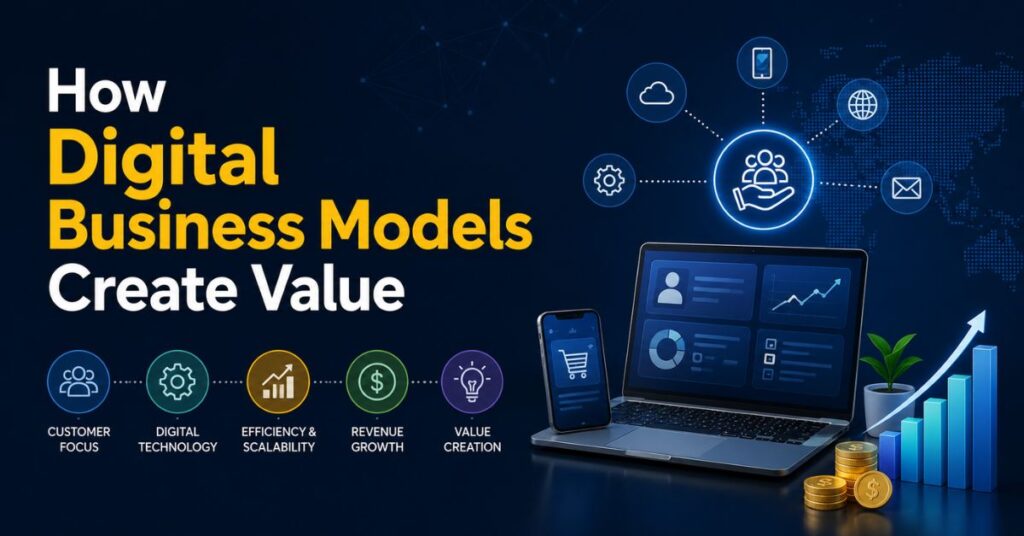
A digital business becomes valuable when it solves a real problem in a way customers understand and appreciate. That sounds simple, yet many weak businesses start from the opposite direction. They choose a product first and then search for buyers.
A stronger digital business strategy starts with customer needs. It asks what people struggle with, what they currently use, what those solutions cost, and where the gaps are. This approach creates a more reliable business planning process.
Value also depends on how efficiently the company delivers its solution. A useful digital business model should explain who pays, what they receive, how the company reaches them, and how much it costs to operate. When those pieces fit together, the company has a clearer path toward sustainable business growth. Without that foundation, increasing traffic or advertising may simply increase expenses.
See Also: Almawadahit.com Review 2026: Honest Truth & Key Facts
Identifying a Real Business Problem
A strong business idea usually begins with a problem that people already recognize. For example, a small retailer might struggle to track orders across several sales channels. A digital service could solve that problem by combining order information into one dashboard.
The opportunity becomes stronger because the service saves time and reduces confusion. This is more meaningful than launching a product simply because a particular technology happens to be popular.
Understanding Your Target Audience
Knowing your target audience changes almost every part of a business. You need to understand who your target customers are, what they want, what they can afford, and how they make purchasing decisions. Customer research, surveys, interviews, search behavior, reviews, and customer feedback can reveal useful patterns. When you understand those patterns, your messaging becomes clearer and your products and services can match genuine customer needs.
Creating a Sustainable Revenue Model
A business also needs a reliable revenue model. Some companies earn money from direct product sales. Others use subscriptions, service fees, advertising, commissions, licensing, or a mixture of several sources. The right choice depends on the market and the value being delivered. Entrepreneurs should also consider business expenses, profit margins, customer acquisition costs, and recurring revenue. A business can have thousands of users and still struggle if its financial structure does not work.
Testing an Idea Before Scaling
Testing an idea before spending heavily is one of the simplest ways to reduce uncertainty. You can start with a small product, limited service, landing page, pilot program, or early customer group. The purpose is to collect real business data before committing large amounts of money. If customers respond positively, you have evidence for further development. If they do not, you can change direction while the cost of failure remains manageable.
See Also: RobTheCoins Investing: Complete Guide to Investing & Crypto
The Role of Cryptocurrency in Business RobTheCoins

Cryptocurrency can play a role in some digital businesses, but it should not automatically become the center of a business strategy. A company might use digital assets for payments, blockchain-based records, smart contracts, or other technical functions. Another business may have no practical reason to use cryptocurrency at all. The correct choice depends on the problem being solved. Adding crypto simply because it sounds innovative can create unnecessary complexity.
For businesses that do use cryptocurrency, careful risk management becomes even more important. Digital assets can experience significant price changes. Rules can differ between countries. Security mistakes can become costly. Tax treatment may also vary by jurisdiction. Therefore, cryptocurrency should be treated as one part of a wider business system rather than as a shortcut to business success.
How Cryptocurrency Can Support Digital Businesses
Cryptocurrency may support digital businesses through digital payments, international transfers, programmable transactions, and blockchain-based services. In some cases, it can provide an alternative payment method for customers in different markets. However, transaction costs, price volatility, customer familiarity, compliance obligations, and security all need consideration. A business should adopt cryptocurrency because it solves a genuine operational or customer problem, not simply because it is fashionable.
Understanding Blockchain Technology
Blockchain technology provides a shared digital record that can store transaction information across a distributed network. Depending on the blockchain, applications may support programmable agreements known as smart contracts. This technology can help with areas such as digital ownership, transaction records, and automated processes. Still, blockchain is not magic. A company must consider speed, cost, privacy, usability, governance, and legal requirements before choosing it.
Potential Business Use Cases
Potential use cases include international payments, supply-chain records, digital ownership, tokenized assets, decentralized applications, and automated agreements. For example, a company could use blockchain records to improve visibility across a supply chain. Another company might use smart contracts for specific automated transactions. The important question remains practical: does the technology produce a meaningful advantage over simpler alternatives?
How to Start a Business RobTheCoins Strategy
Starting with a clear plan gives a new business a better chance of surviving early uncertainty. A useful startup strategy does not require a complicated document filled with impressive words. It needs a clear understanding of the customer, market, offer, costs, revenue, and operating process. These elements create a practical business planning framework that can guide daily decisions.
The same approach works whether you are exploring a conventional online business or something connected with cryptocurrency. Start small. Collect evidence. Improve the offer. Then scale when the numbers and customer response support the next step. This creates steady growth rather than relying on one large gamble.
Research and Planning
Good market research should examine customer demand, competitors, pricing, industry trends, and possible barriers. Study what existing businesses do well. Look for gaps that customers complain about. Examine whether people already spend money on similar products or services. This information gives you a stronger basis for business decision-making and helps turn a vague idea into a workable business plan.
Choose the Right Business Model
Your business model should explain how the company creates value and earns money. A service business may charge clients directly. An online store may earn a margin on products. A software company may use subscriptions. A marketplace may charge transaction fees. A crypto-enabled business may add blockchain functionality to one of these models. The technology can vary, but the economic logic still needs to make sense.
Select Useful Digital Tools
The right business tools can make daily work easier. Project management platforms can support task management. Accounting software can simplify financial tracking. CRM systems can organize customer information. Analytics platforms can show how visitors behave. Communication tools can improve team collaboration. However, buying dozens of applications does not create better operations. Choose tools that solve specific problems and fit your workflow.
Set Clear Business Goals
Effective business goals should give you something measurable to work toward. Instead of saying that you want more sales, decide how much revenue you want to generate and by when. You might also track customer retention, conversion rates, website traffic, or average order value. Goal setting gives your team direction and turns a broad ambition into practical action.
Practical Business RobTheCoins Growth Strategies
Real growth rarely happens because of one clever trick. It usually comes from repeated improvements across marketing, operations, customer service, and finances. Strong business growth strategies connect these areas instead of treating them as separate activities. When your strategy, execution, and measurement work together, you can see what deserves more investment and what needs to change.
A good growth roadmap should remain flexible. Markets change. Customer behavior changes. Competitors introduce new offers. New technologies appear. The goal is not to predict everything perfectly. It is to build an adaptable business that can respond without losing its direction.
Build a Strong Business Strategy
A strong business strategy starts with a clear position in the market. You need to know what makes your offer useful and why customers should choose it. This may involve better service, lower friction, stronger expertise, convenience, specialization, or a distinctive customer experience. Over time, these strengths can become a competitive advantage that is difficult for competitors to copy quickly.
Use Digital Marketing Effectively
Digital marketing works best when it connects with real customer needs. Search engine optimization can help people find useful information. Social media can build awareness and community. Email can support retention. Paid advertising can generate targeted traffic. A strong digital marketing strategy combines these channels according to the audience and business model rather than trying every platform at once.
Track Financial Performance
Revenue alone does not tell you whether a business is healthy. Financial tracking should also consider expenses, cash flow, margins, customer acquisition costs, and recurring income. Business analytics can connect financial results with customer behavior. When an entrepreneur understands the numbers, marketing decisions become more informed and spending becomes easier to control.
Scale Your Business Carefully
Business scalability means growing without allowing costs and complexity to increase at the same rate. Automation can help. Better systems can help. Clear processes can help. However, scaling before validating demand can turn a small problem into a large one. Careful growth protects financial stability and supports long-term business growth.
Risks of Business RobTheCoins and Digital Opportunities
Every business opportunity carries some level of business risk. Digital businesses face familiar challenges such as changing demand and competition. Crypto-related businesses can add further concerns involving asset volatility, regulation, security, and technical failures. Recognizing these risks does not mean avoiding innovation. It means making decisions with open eyes.
Good risk management starts with identifying what could go wrong and deciding how to reduce the impact. An entrepreneur might diversify income, keep emergency funds, protect customer data, use secure systems, and review legal requirements. Emergency planning becomes especially valuable when a business depends heavily on one platform, payment method, customer group, or revenue source.
Market and Financial Risk
Markets can change quickly. Customer demand may fall. Advertising costs can rise. A competitor may release a better product. Cash flow can become tight even when sales appear healthy. Financial planning helps businesses prepare for these situations. Building several income sources can also reduce dependence on one channel and improve resilience during uncertain periods.
Cryptocurrency and Regulatory Risk
Cryptocurrency introduces additional uncertainty because regulations and market conditions can change. Different countries may treat digital assets differently for taxation, reporting, licensing, or consumer protection. Price volatility can also affect businesses that hold crypto assets. Anyone considering a crypto-related business should check the rules that apply to their specific country and business activity before operating.
Cybersecurity Risk
Digital businesses must protect accounts, systems, payment information, and customer data. Common threats include phishing, malware, account theft, fraudulent transactions, and data breaches. Strong passwords, multi-factor authentication, software updates, secure backups, and staff awareness can reduce exposure. If cryptocurrency wallets are involved, security becomes even more important because unauthorized transfers may be difficult or impossible to reverse.
Competition and Reputation Risk
A crowded market can make customer acquisition expensive. At the same time, poor service can damage a company’s reputation quickly. Online reviews and social media can amplify both positive and negative experiences. A customer-focused business should therefore treat trust as an operating asset. Clear communication, honest claims, reliable support, and consistent service can strengthen the customer base over time.
Common Business RobTheCoins Mistakes to Avoid
Many business mistakes happen because people rush into execution before understanding the market. Excitement can be useful, but it should not replace evidence. A careful business development strategy gives you time to test assumptions and understand what customers actually want. This is particularly important when an opportunity involves unfamiliar technology or financial claims.
Avoiding mistakes does not mean trying to create a perfect business. Continuous improvement matters more than perfection. You will learn from customers, numbers, competitors, and your own experience. The key is to identify weak points early and adjust before they become expensive.
Poor Research and Planning
Skipping research can lead to weak pricing, poor positioning, and products nobody wants. A detailed business plan does not guarantee success, but it can expose gaps before money is committed. Spend time understanding the market, customers, and competitors before building too much.
Scaling Too Quickly
Rapid expansion can create pressure on cash flow, staff, customer support, and quality. A company that receives more orders than it can fulfill may damage its reputation while trying to grow. Controlled testing provides a safer path. Scale after demand, operations, and finances show that the business can handle the increase.
Ignoring Security and Regulations
Ignoring security can expose both the business and its customers to serious harm. Ignoring regulations can create fines, legal problems, or operational restrictions. This becomes especially important for companies handling payments, personal information, financial services, or digital assets. Compliance should form part of the business foundation rather than become an afterthought.
Failing to Validate Business Claims
Online claims should always receive careful scrutiny. A statement about revenue, users, partnerships, technology, or investment performance should have evidence behind it. Look for independent information instead of relying only on promotional pages. Business data and verifiable documentation are much more useful than exaggerated testimonials.
How to Evaluate RobTheCoins Business Information
Evaluating information is one of the most important skills when researching Business RobTheCoins. A polished website does not automatically establish credibility. Neither does a large social media following. You should examine who operates the service, what it actually provides, how it makes money, what risks exist, and whether independent evidence supports its claims.
This approach is especially important when business information overlaps with investment language. A useful business opportunity can still be risky. An interesting technology can still fail commercially. Separating facts from promises allows you to make better decisions without being influenced by hype.
Check the Source and Evidence
Start with the original source whenever possible. Examine official documentation, company information, terms of service, regulatory information where relevant, and independent reporting. Look for specific facts rather than vague statements. If a claim cannot be verified through credible evidence, treat it as unconfirmed rather than assuming it is true.
Separate Business Ideas From Investment Claims
A business strategy and an investment opportunity are not the same thing. A company may discuss digital entrepreneurship while another page may promote a financial product using similar language. The difference matters. Business education can explain how to create value, while an investment claim makes assertions about financial returns. These claims require different levels of scrutiny.
Look for Transparency and Clear Information
Transparency gives readers useful information about how an operation works. Check whether the organization clearly explains its products and services, ownership, fees, terms, risks, and contact details. Vague descriptions make evaluation harder. Clear information does not guarantee that an opportunity will succeed, but missing information should encourage additional caution.
Avoid Guaranteed Profit Promises
No genuine market opportunity should be treated as a guaranteed path to wealth. Phrases such as guaranteed profit, risk-free income, or instant returns should raise concern. Real businesses face competition, expenses, customer changes, and uncertainty. A credible explanation acknowledges those realities rather than pretending they do not exist.
Business RobTheCoins vs Traditional Business Models
The comparison between Business RobTheCoins and traditional business models is useful only when the underlying business activities are clearly understood. Digital models often rely heavily on websites, software, online payments, data, and remote customer acquisition. Traditional companies may depend more on physical locations, inventory, local relationships, or established distribution systems. Many modern businesses combine both approaches.
Neither structure is automatically superior. A restaurant still needs good operations even when it uses digital ordering. An online company still needs sound financial management. The best structure depends on the market, customer expectations, available resources, and legal environment. This is why flexible business models can be useful when market conditions change.
Key Differences
Digital models can reach customers across wider geographic areas with relatively low physical overhead. They can also use automation and analytics to improve operations. Traditional models may benefit from physical presence, direct interaction, established supply chains, or strong local relationships. The difference often comes down to how the business delivers value rather than whether one model is inherently better.
Advantages and Limitations
A digital model can offer flexibility, lower entry barriers, and strong opportunities for automation. However, it may also face intense online competition and dependence on technology platforms. Traditional models can create strong local trust and physical experiences, but expansion may require more capital. Each structure has strengths and limitations, so business decision-making should consider the complete picture.
Which Model May Suit You?
The right choice depends on your industry, skills, capital, audience, and goals. A freelancer may naturally begin with a digital service model. A manufacturer may need physical facilities while using digital tools for sales and operations. A company can also combine online and offline methods. The best small business strategy is the one that matches customer needs while remaining financially and operationally realistic.
Tools and Resources for Digital Business Growth
Technology can make a major difference when it supports a clear process. Useful productivity tools can reduce repetitive work. CRM software can organize customer relationships. Analytics platforms can reveal performance trends. Accounting systems can simplify financial records. The purpose of these tools is not to make a business look sophisticated. Their purpose is to save time, reduce errors, and improve decisions.
As a business grows, business automation can handle repetitive tasks such as email sequences, appointment reminders, reporting, and basic customer communication. Workflow management can also make responsibilities clearer. However, automation should improve the customer experience rather than create a maze of impersonal processes.
Free Tools for Beginners
Beginners can start with simple solutions for documents, spreadsheets, communication, task management, analytics, and social media. Free options can provide enough functionality to test a business model before paying for advanced systems. The important point is to understand the process first. A paid tool cannot fix an unclear workflow.
Paid Tools for Scaling
Growing businesses may need advanced CRM systems, accounting platforms, marketing automation, analytics, project management, and collaboration software. Paid systems can save substantial time when the business has enough activity to justify the cost. Before upgrading, compare the subscription price with the hours saved, errors reduced, and additional revenue the system may support.
Financial and Security Resources
Financial tools should help you understand income, expenses, cash flow, and taxes. Security resources should protect accounts, devices, customer information, and digital assets. Multi-factor authentication, secure password management, backups, and access controls form part of a sensible security framework. For regulated industries or crypto-related activity, professional legal and financial advice may also be appropriate.
Future of Business RobTheCoins in the Digital Economy
The future of Business RobTheCoins should be considered within the broader evolution of the digital economy. Businesses continue to adopt automation, artificial intelligence, digital payments, online commerce, and data-driven decision-making. Blockchain may also find useful applications where its specific features provide value. However, not every new technology becomes a successful business. Adoption usually depends on cost, usability, customer demand, security, and regulation.
For entrepreneurs, the bigger lesson is adaptability. A strong growth strategy should leave room for change. Businesses that keep learning can adjust their products, channels, and operations as markets develop. This creates business resilience and supports long-term success even when specific technologies or trends change.
Emerging Business and Crypto Trends
Digital payments, AI-powered services, creator businesses, automation, tokenization, and online marketplaces continue to shape entrepreneurship. These trends create new online business opportunities, but they also create more competition. Entrepreneurs should focus on customer value rather than chasing every new trend. A technology becomes useful when it improves a real part of the business.
Blockchain Adoption
Blockchain adoption may grow in areas where shared records, digital ownership, programmable transactions, or decentralized systems provide practical benefits. Businesses will still compare blockchain with conventional databases and payment systems. Cost and complexity matter. If a simpler technology solves the same problem more effectively, blockchain may not be necessary.
Future Growth Opportunities
Future opportunities may emerge across financial technology, digital services, global e-commerce, software, automation, online education, and blockchain applications. Entrepreneurs who combine technical awareness with strong customer research may find new niches. The most durable opportunities are likely to come from solving real problems rather than relying on speculative excitement.
Frequently Asked Questions
What Is Business RobTheCoins?
There’s no established or widely recognized business model by this name. Treat any content using this term with caution until you can verify who’s behind it.
Is RobTheCoins a Cryptocurrency Platform?
There’s no verifiable, legitimate platform officially operating under this name. Search for a registered company, whitepaper, or regulatory filing before assuming it’s real.
Is Business RobTheCoins Suitable for Beginners?
Since it isn’t a defined or verified business model, this can’t be answered meaningfully. Beginners should stick to well-documented, verifiable frameworks instead.
Does RobTheCoins Guarantee Investment Profits?
No legitimate business or investment can ever guarantee profits. Any claim promising guaranteed returns is a major red flag for fraud.
What Are the Main Risks of Crypto-Related Businesses?
Crypto businesses face market volatility, regulatory uncertainty, and cybersecurity threats like hacks and scams. They also carry higher fraud risk due to limited oversight in some regions.
Can Cryptocurrency Alone Build a Successful Business?
No, cryptocurrency is a tool or payment layer, not a business model by itself. Success still requires a real product, audience, and revenue plan.
How Should You Evaluate an Online Business Opportunity?
Check for a verifiable company, transparent leadership, and real customer reviews outside the platform itself. Be skeptical of guaranteed returns, pressure to recruit others, or vague explanations of how money is actually made.
Final Thoughts
Business RobTheCoins sits at the intersection of several topics that attract modern entrepreneurs: digital business, online opportunities, cryptocurrency, blockchain, and growth strategy. Because the term can appear in different contexts, careful evaluation matters. It is better to verify what a specific claim means than to assume that every online description refers to the same business or service.
The strongest lessons are practical. Start with a real problem. Understand your target audience. Build a sensible business model. Set clear goals. Use useful digital tools. Track financial performance. Protect customer information. Review your progress and adapt when the evidence tells you to change direction. These habits create a stronger business foundation than chasing quick wins.

Ryan Mitchell is a writer and language enthusiast at MeaningZen. He creates simple guides on slang, word meanings, grammar, and modern internet language. His goal is to make confusing words and phrases easy to understand.