
Tech Hacks PBLinux Gaming: Complete Guide to Linux Gaming Performance in 2026
Linux gaming isn’t a niche hobby anymore. It’s a real option for anyone who wants speed, control, and freedom from bloated software. If you’ve ever wondered how to squeeze more frames out of your rig without buying new hardware, this guide is for you. We’ll walk through every part of Tech Hacks PBLinuxGaming, from picking the right distro to fixing stubborn audio bugs. Grab a coffee. This one’s long, but it’s worth it.
What Is Tech Hacks PBLinuxGaming?
Tech Hacks PBLinuxGaming is a simple idea. It means using smart, tested methods to get better Linux gaming performance without spending extra money on hardware. Think of it as a toolbox. Inside, you’ll find driver fixes, kernel tweaks, and small settings changes. Each one adds a little speed. Stack enough of them together, and your games run smoother than you thought possible.
This isn’t about one magic trick. It’s about layering small wins. A better graphics driver here. A shader cache fix there. Add GameMode, add MangoHud, and suddenly your FPS graph looks a lot happier. That’s the whole philosophy behind Linux gaming optimization: small changes, real results.
How PBLinuxGaming Tech Hacks Improve Gaming Performance
Every tweak in this guide targets one of three things: your CPU, your GPU, or your system’s background noise. Your CPU handles game logic and physics. Your GPU renders the picture. And background processes? They quietly steal resources from both. Linux performance tweaks work by giving your hardware room to breathe.
Picture your PC like a kitchen during a dinner rush. If ten unnecessary cooks are wandering around doing nothing useful, the chef can’t work fast. Close those “cooks” down, tune your CPU governor, and update your graphics drivers. Suddenly the chef—the GPU—has room to plate every dish faster. That’s gaming performance optimization in a nutshell.
Who Can Benefit From Linux Gaming Optimization
Almost anyone. Budget gamers with older laptops benefit the most, since Linux gaming tweaks often revive hardware that felt sluggish on Windows. Competitive players chasing every last frame benefit too, especially from frame pacing and input latency fixes. And Steam Deck owners? They’re already living inside a fully optimized Linux gaming machine, so this guide helps them go even further.
The State of Linux Gaming in 2026
Linux gaming in 2026 looks completely different from five years ago. Back then, running a big AAA title on Linux felt like a gamble. Tech Hacks PBLinux Gaming Today, thanks to Proton, Vulkan, and the massive success of the Steam Deck, most modern games run well right out of the box. Valve’s continued investment in Proton has closed the compatibility gap almost completely for single-player titles.
Gaming on Linux used to mean compromise. Now it often means choice. Many players run Linux full-time and never touch Windows again. Native titles like Dota 2 and Counter-Strike 2 run beautifully, and thousands of Windows-only games run through Proton with barely any noticeable slowdown. The ecosystem has matured, and it shows.
Native Linux Games vs Windows Games on Linux
Native games are built specifically for Linux. They don’t need a translation layer, so they tend to run with slightly less overhead. Popular examples include Dota 2, Counter-Strike 2, Valheim, and Team Fortress 2. These games talk directly to your GPU drivers without any middleman.
Windows games on Linux go through Proton, Valve’s compatibility layer built on Wine. It translates Windows API calls into something Linux understands. Modern Proton versions are so refined that many Windows games now perform close to their native Windows benchmarks, and in some cases, they even run better thanks to lower system overhead.
Can Linux Run AAA Games Smoothly?
Yes, in most cases. Thanks to Proton and steady Linux game optimization work from the community, big-budget titles usually launch and run well. Checking ProtonDB before buying a game is still smart, though, since a small number of titles still struggle, mostly because of aggressive anti-cheat systems that haven’t added Linux support yet.
| Game Type | Typical Linux Performance |
| Native Linux titles | Excellent, near-identical to design intent |
| Proton “Platinum” rated games | Excellent, minimal FPS loss |
| Proton “Gold” rated games | Very good, minor tweaks may help |
| Games with kernel-level anti-cheat | Often blocked or unstable |
Best Linux Distros for Gaming Performance
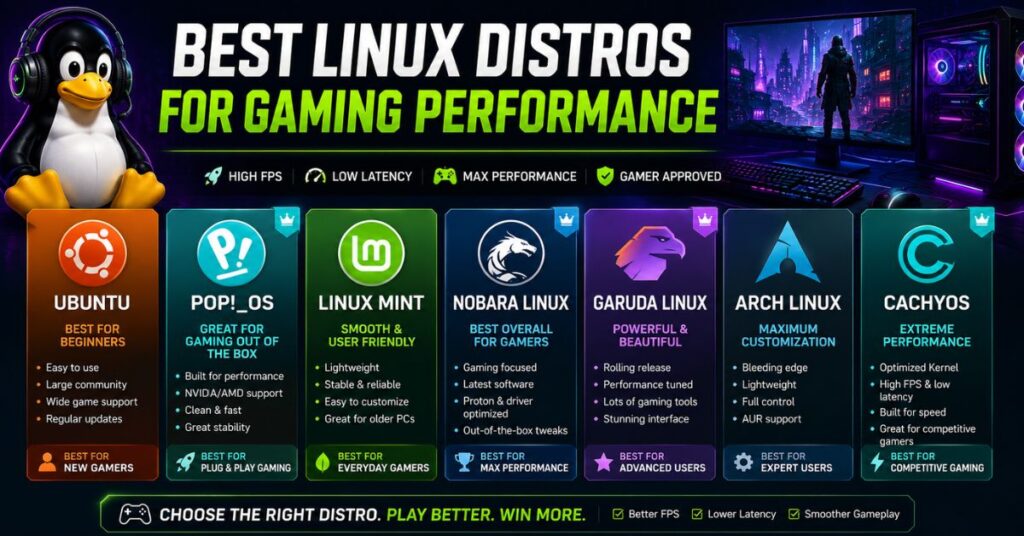
Your distro is the base layer of your entire Linux gaming setup. Pick wrong, and you’ll spend hours fighting drivers instead of playing games. Pick right, and everything just works. Some distros focus on stability, some focus on raw performance, and some hand you a preconfigured gaming rig on install day.
The good news? Tech Hacks PBLinux Gaming There’s no wrong answer anymore, only a better fit for your skill level. Beginners want simplicity. Advanced users want control. Performance chasers want a distro tuned within an inch of its life. Let’s break down each group.
Best Linux Distros for Beginners
Ubuntu remains the friendliest starting point, with huge community support and tons of documentation for any problem you hit. Pop!_OS deserves special mention too, since its NVIDIA GPU support is genuinely excellent out of the box. Linux Mint rounds out the trio nicely, offering a clean, familiar desktop that doesn’t fight you at every turn.
Best Linux Distros for Advanced Gamers
Arch Linux gives you total control and the newest software the moment it releases, which matters a lot for Linux gaming performance on brand-new hardware. Manjaro softens Arch’s learning curve while keeping most of its power. Garuda Linux goes a step further, shipping with gaming tweaks and tools already baked in.
Performance-Focused Gaming Distros: Nobara, CachyOS and Others
Nobara Linux was built by a Fedora developer specifically for gamers, and it shows. It ships with Proton GE, tuned drivers, and gaming fixes already applied. CachyOS has exploded in popularity too, thanks to its optimized Linux kernel and scheduler, both tuned for lower system latency. Fedora’s gaming spins also deserve a mention for combining bleeding-edge software with solid stability.
Optimize Graphics Drivers for Better Linux Gaming
GPU drivers are the foundation everything else sits on. You can tune your kernel all day, but if your drivers are outdated or misconfigured, you’re leaving huge performance on the table. This is usually the very first thing to check in any Linux gaming guide, and for good reason.
Different GPU brands need different approaches. AMD GPU owners generally have it easiest, thanks to open-source drivers built right into the kernel. NVIDIA GPU owners need to install proprietary drivers manually, and Intel Arc owners are riding a wave of rapid improvement that’s finally making Arc a real gaming option.
AMD Drivers for Linux Gaming
AMD’s open-source Mesa drivers are frequently updated and deeply integrated into the Linux kernel. This means Linux graphics optimization for AMD often requires almost no manual work. Vulkan performance on AMD cards tends to be excellent, and driver installation is usually automatic on most modern distros.
NVIDIA Drivers for Linux Gaming
NVIDIA still leans on proprietary drivers for the best performance. Installing the latest stable driver, enabling Vulkan support, and keeping everything updated regularly are the three golden rules here. Pop!_OS and Nobara both simplify this process significantly compared to a bare Arch or Debian install.
Intel Arc Graphics Support for Gaming
Intel Arc has come a long way. Recent Mesa driver updates boosted Vulkan performance, DirectX translation quality, and general driver stability. It’s not quite at AMD or NVIDIA’s level yet for high-end gaming, but for budget and mid-range setups, Arc has become a genuinely solid choice.
Proton, Proton GE and Wine: Which Should You Use?
This is one of the most common questions in any Linux gaming guide, and the answer depends on what you’re trying to run. Proton works for the vast majority of games straight out of Steam. Proton GE adds community patches for trickier titles. Wine sits underneath both, and advanced users sometimes use it directly for non-Steam software.
| Tool | Best For | Setup Difficulty |
| Proton (official) | Most Steam games | Very easy |
| Proton GE | Tricky or newer titles | Easy, needs manual install |
| Wine | Non-Steam apps and games | Moderate to advanced |
How Proton Works on Linux
Proton translates Windows API calls into instructions Linux can understand. It bundles DXVK and VKD3D to convert DirectX calls into Vulkan, which your GPU actually speaks natively. This translation happens fast enough that most players never notice it’s even running.
Is Proton GE Worth Installing?
Yes, for most gamers. Proton GE includes community patches that haven’t made it into official Proton yet. It often fixes video playback issues, adds support for newer anticheat systems, and squashes bugs faster than the official branch. Installing it takes just a few minutes through ProtonUp-Qt.
How to Use ProtonDB Before Installing a Game
Before buying any game, search its name on ProtonDB. You’ll see a rating: Platinum, Gold, Silver, or Bronze. Platinum means flawless out of the box. Gold usually means minor tweaks help. Silver and Bronze mean you should read user reports carefully before spending money.
Vulkan Optimization for Maximum FPS and Less Stutter
Vulkan changed the game for Linux FPS boost potential. Unlike older APIs like OpenGL, Vulkan talks to your CPU and GPU far more efficiently. It spreads work across multiple CPU cores instead of dumping everything onto a single thread, which is exactly where older APIs used to choke.
This lower overhead means smoother frame times, less stuttering, and better use of modern multi-core processors. Most Proton games already run on Vulkan through DXVK, so you’re likely benefiting from this without even realizing it.
Why Vulkan Can Improve Linux Gaming Performance
Vulkan reduces CPU overhead dramatically compared to older graphics APIs. It gives developers direct control over the GPU, which cuts out layers of translation that used to slow things down. The result: better frame pacing, lower input latency, and stronger use of every CPU core you own.
Shader Caching and Stutter Reduction
Shader compilation is one of the biggest causes of mid-game freezes. When a game encounters a new visual effect for the first time, it has to compile a shader on the spot, causing a hitch. Shader caching stores these compiled shaders so the game never has to redo that work. Enabling shader pre-caching in Steam settings noticeably reduces first-playthrough stutter.
Common Vulkan Problems and Fixes
Most Vulkan issues trace back to outdated Mesa drivers or a corrupted shader cache. Updating your drivers and clearing the shader cache folder usually solves the problem. Running vulkaninfo in a terminal confirms whether Vulkan is properly installed and recognized by your system.
Steam Optimization Hacks for Linux Gamers
Steam remains the backbone of most Linux PC gaming setups, and it comes packed with hidden settings most players never touch. A handful of launch options and background process tweaks can meaningfully improve your gaming optimization settings without installing anything extra.
These hacks take minutes to apply but pay off every single time you launch a game. They’re some of the lowest-effort, highest-reward tweaks in this entire guide.
Essential Steam Launch Options for Better Performance
| Launch Option | What It Does |
| gamemoderun %command% | Activates GameMode automatically |
| mangohud %command% | Shows FPS and hardware stats overlay |
| DXVK_ASYNC=1 %command% | Reduces shader compilation stutter |
How to Enable Steam Shader Pre-Caching
Open Steam’s settings, head to the Shader Pre-Caching section, and make sure it’s turned on. This lets Steam download precompiled shaders from other players’ systems, which drastically cuts down on first-launch stutter for popular titles.
Managing Background Processes While Gaming
Closing browser tabs, chat overlays, and unused sync services frees up both RAM and CPU cycles. Even small savings here add up, especially on systems with 8GB of RAM or less, where every bit of freed memory translates directly into smoother frame times.
CPU and Kernel Tweaks for Linux Gaming Performance
The Linux kernel controls how your CPU schedules tasks, and gamers have several specialized kernel options to choose from. This is where Linux performance tuning gets a bit more technical, but the payoff can be real, especially for competitive players chasing consistent frame times.
Not every gamer needs a custom kernel. But if you’re already comfortable tinkering, this is one of the more rewarding areas to explore.
Zen vs Liquorix vs Default Kernel for Gaming
| Kernel | Focus | Best For |
| Default kernel | General stability | Most casual gamers |
| Zen kernel | Desktop responsiveness | Gamers wanting snappier feel |
| Liquorix kernel | Multimedia and gaming tuning | Enthusiasts chasing low latency |
Choosing the Right CPU Governor
The CPU governor decides how aggressively your processor ramps up its clock speed. The Performance governor keeps clocks high for maximum FPS. Schedutil balances power and speed. Powersave prioritizes battery life over performance, which laptop gamers should avoid during actual play sessions.
See Also: My Green Bucks.net: Latest News, Updates & Earning Guide 2026
⭐ When Kernel Tweaks Are Actually Worth Using
Honestly, most casual gamers won’t notice a custom kernel at all. Where it really matters is on older or lower-spec hardware, where every bit of scheduling efficiency counts, or in competitive titles where consistent frame times matter more than raw average FPS. If your system already runs smoothly, skip this step and focus on drivers and storage instead.
RAM, Storage and Memory Optimization for Gaming
Memory management plays a bigger role in Linux gaming performance than most players realize. Poor swap behavior can cause sudden freezes, while a slow drive turns loading screens into coffee breaks. This section covers the quiet fixes that make a noticeable difference.
Get these settings right once, and you’ll rarely think about them again. They’re a “set it and forget it” category of tweak.
Swappiness Settings for Gaming
Swappiness controls how eagerly Linux moves data from RAM to your swap file. A high value means your system swaps often, even with RAM free, which can hurt performance. Lowering swappiness to around 10 keeps active game data in fast RAM for longer, reducing stutter on memory-heavy titles.
ZRAM and Its Benefits for Gaming
ZRAM compresses data directly inside RAM instead of writing it to a slower disk-based swap file. This gives systems with limited RAM a meaningful performance cushion, since compressed swap in memory is far faster than swap on even a good SSD.
Does an NVMe SSD Improve Gaming Load Times?
Absolutely. An NVMe SSD dramatically improves SSD load times compared to older SATA drives or spinning hard disks. Games load faster, textures stream in quicker during open-world exploration, and level transitions feel almost instant. If you’re still gaming off a hard drive in 2026, this is the single biggest upgrade available.
Essential Linux Gaming Performance Tools
A handful of community tools have become essential parts of any serious Linux gaming configuration. Each one solves a specific problem, and together they cover almost every performance-monitoring need you’ll have.
Installing all four takes less than fifteen minutes and gives you a genuinely professional-grade gaming setup.
GameMode for Automatic Performance Optimization
GameMode automatically switches your CPU governor to Performance mode, adjusts process priorities, and applies other tweaks the moment a game launches, then reverts everything once you quit. It requires zero manual intervention after the initial setup.
MangoHud for FPS and Performance Monitoring
MangoHud overlays real-time stats directly on your screen: FPS, CPU usage, GPU usage, temperatures, and frame times. It’s the single best tool for confirming whether a tweak actually helped or just felt like it helped.
CoreCtrl for AMD GPU Management
CoreCtrl gives AMD GPU owners a graphical way to manage fan curves, power limits, and clock speeds, something that used to require editing config files manually.
GreenWithEnvy for NVIDIA GPU Control
GreenWithEnvy offers similar functionality for NVIDIA GPU owners, providing overclocking controls and detailed monitoring in a clean graphical interface.
Reduce Input Lag, Latency and Frame-Time Problems
High FPS numbers mean little if your input latency is high. A game can show 200 FPS and still feel sluggish if there’s a delay between pressing a button and seeing it happen on screen. This section tackles the “feel” of gaming, not just the numbers.
Competitive players especially should pay close attention here, since even small latency reductions can meaningfully improve reaction times in fast-paced games.
Optimize Refresh Rate and Frame Rate
Matching your monitor’s refresh rate to a frame rate your system can actually sustain matters more than chasing the highest possible FPS number. A stable 120 FPS on a 120Hz display feels far better than a jumpy 180 FPS that keeps dipping and spiking.
Wayland vs X11 for Gaming
Wayland has improved massively and now offers better security and lower overhead than it once did. X11 still holds a slight edge in a handful of older games with specific compatibility quirks. Testing both on your specific game library is the smartest approach.
How to Improve Frame Pacing
Frame pacing refers to how evenly spaced your frames are delivered, not just how many you get per second. Enabling VSync carefully, or using tools that smooth frame delivery, often feels better than disabling every frame limiter and chasing raw numbers.
⭐ How to Find the Real Cause of Input Lag
Start by checking your display’s response time, then test your input device for polling rate issues, and finally rule out software-level buffering in the game’s graphics settings. If you’re playing online, don’t forget network latency as a possible culprit, since a laggy connection can feel identical to a rendering problem even though the cause is completely different.
See Also: TheSindi com: Complete Guide to Features, Content & User Experience 2026
Network Optimization for Competitive Linux Gaming
For online games, your network matters just as much as your GPU. Network latency, or ping, determines how quickly your actions register on the game server. A few smart network tweaks can shave meaningful milliseconds off your connection.
This section is especially important for competitive shooters and fighting games, where even small delays can be the difference between winning and losing a match.
Wired vs Wi-Fi for Competitive Gaming
A wired Ethernet connection consistently beats Wi-Fi for competitive play, offering lower latency, fewer dropped packets, and far more stable connections overall.
DNS Optimization for Online Games
| Provider | DNS Address |
| Cloudflare | 1.1.1.1 |
| Google DNS | 8.8.8.8 |
| Quad9 | 9.9.9.9 |
DNS optimization won’t reduce in-game ping directly, but it does speed up matchmaking and server connection times noticeably.
How to Reduce Bufferbloat and Ping Spikes
Bufferbloat happens when your router queues too much data at once, causing sudden ping spikes during heavy network activity. Modern routers with Quality of Service, or QoS, features help keep gaming traffic prioritized even while other devices are streaming or downloading in the background.
How to Benchmark Linux Gaming Performance Correctly
Raw FPS numbers alone don’t tell the full story of your Linux gaming performance. Proper Linux gaming benchmark habits reveal whether a tweak genuinely helped or whether you’re just imagining an improvement.
Getting this right saves you hours of guesswork and lets you make decisions based on actual data instead of vibes.
Understanding Average FPS vs 1% Lows
Average FPS tells you the overall picture, but 1% lows reveal the worst stutters you actually experience during gameplay. A game averaging 120 FPS with 1% lows around 40 FPS will feel noticeably choppier than the average number suggests.
Best Benchmarking Tools for Linux Games
MangoHud, GOverlay, the Phoronix Test Suite, and vkBasalt are the most reliable benchmark tools available for Linux gamers today, each offering different levels of detail and control.
⭐ How to Compare FPS Before and After an Optimization
Use the exact same save file or benchmark scene every time. Keep every graphics setting identical between tests. Log your results with MangoHud, then compare both the average FPS and the 1% lows side by side. Without this discipline, it’s easy to convince yourself a placebo tweak actually worked.
Common Linux Gaming Problems and How to Fix Them
Even a fully optimized system runs into occasional problems. This is normal, and most issues have simple, well-documented fixes. This section covers the most common headaches in Linux gaming troubleshooting.
Don’t panic when something breaks. Nine times out of ten, the fix is quick.
Games Refusing to Launch
Missing dependencies, an incorrect Proton version, or a driver conflict are the usual suspects. Verifying game files through Steam and checking ProtonDB for the recommended Proton version solves most launch failures.
Audio Problems in Linux Games
Audio issues are often solved by switching to PipeWire, verifying your output device is correctly selected, or reconfiguring your sound server settings entirely.
Controller Detection and Compatibility Issues
Controller support problems usually clear up after enabling Steam Input, updating your controller’s firmware, or simply reconnecting the device fresh.
Anti-Cheat Compatibility on Linux
Anti-cheat support has improved a lot, but it’s still inconsistent. Checking a site like areweanticheatyet.com before buying a competitive multiplayer game saves a lot of frustration.
⭐ How to Roll Back an Optimization That Causes Problems
Take a system snapshot with a tool like Timeshift before making any major change. If a kernel update, driver switch, or tweak causes instability, you can revert instantly instead of troubleshooting blind for hours.
Are Linux Gaming Optimization Hacks Safe?
Yes, the vast majority of Linux gaming tips in this guide carry little to no risk. Updating drivers, installing GameMode, or enabling shader pre-caching are all safe, reversible actions that thousands of gamers use daily without issue.
That said, a few advanced tweaks deserve extra caution, especially for newer Linux users still learning their way around the system.
Low-Risk vs Advanced System Tweaks
Driver updates, GameMode, and MangoHud sit firmly in low-risk territory. Custom kernel compiling, aggressive GPU undervolting, and manual swap partition resizing carry real risk if done carelessly.
Which Tweaks Should Beginners Avoid?
Beginners should steer clear of manually compiling custom kernels and aggressive undervolting without proper temperature monitoring in place. These tweaks offer diminishing returns for the risk involved until you’re more comfortable with Linux system optimization.
Does Linux Actually Improve Gaming Performance?
This is the question everyone eventually asks, and the honest answer is: it depends on the game. For many titles, yes, Linux gaming hacks genuinely increase FPS and reduce stutter. For others, the difference is negligible either way.
Let’s break this down by the most common questions people actually search for.
Do Linux Gaming Hacks Increase FPS?
Yes, in many cases. System tuning, updated drivers, and tools like GameMode can meaningfully improve FPS and reduce lag, particularly on systems that were poorly configured to begin with.
Does Proton Reduce FPS?
In most cases, the performance loss is minimal, often within a few percentage points. Some games running through Proton perform nearly identically to their native Windows versions, and a handful even run better.
Can Linux Improve Older PC Gaming Performance?
Often, yes. Lightweight distributions reduce background overhead significantly compared to modern Windows installations, which can breathe real life into aging hardware.
Linux vs Windows for Gaming Performance
Windows still holds a slight edge in raw native game support, but the gap keeps shrinking every year. For many players, especially those using AMD hardware or the Steam Deck, Linux vs Windows gaming performance is now close enough that the choice comes down to personal preference rather than a hard performance penalty.
See Also: Pushwiki Com: Complete Guide to Features Topics Safety & How It Works in 2026
The Ultimate PBLinuxGaming Optimization Checklist
Here’s a simple roadmap broken into three stages, so you know exactly where to start and where to go next.
Beginner Linux Gaming Checklist
| Step | Action |
| 1 | Install a gaming-friendly distro |
| 2 | Update all graphics drivers |
| 3 | Enable Proton in Steam settings |
| 4 | Install GameMode |
| 5 | Install MangoHud |
Intermediate Performance Checklist
| Step | Action |
| 1 | Confirm Vulkan is working correctly |
| 2 | Move games to an NVMe SSD |
| 3 | Adjust your CPU governor |
| 4 | Enable shader pre-caching |
Advanced Linux Gaming Checklist
| Step | Action |
| 1 | Install a custom kernel like Zen or Liquorix |
| 2 | Tune swappiness and ZRAM settings |
| 3 | Optimize your network with QoS |
| 4 | Benchmark before and after every change |
⭐ What PBLinuxGaming Gets Right And What You Should Avoid
The community behind PBLinuxGaming deserves real credit for tools like GameMode and Proton GE, which solve genuine problems without requiring deep technical knowledge from the average player. These tools represent the best of open-source collaboration.
Where things go wrong is when gamers chase exotic kernel tweaks or aggressive undervolting before fixing the basics. As one longtime Linux gaming contributor put it, “The biggest advantage of Linux gaming is no longer flexibility alone. It’s the combination of performance, customization, and growing compatibility.” Fix your drivers first. Add Proton GE. Install GameMode. Everything else is a bonus, not a requirement.
The Future of Linux Gaming Optimization
Linux gaming 2026 is only the beginning of a much bigger shift. Proton compatibility keeps improving month over month, Wayland adoption keeps growing, and Vulkan performance keeps getting refined by both driver teams and game developers.
The next few years look genuinely exciting for anyone invested in improve Linux gaming efforts long-term.
Steam Deck and the Growth of Linux Gaming
The Steam Deck has done more for Linux gaming adoption than almost anything else in the platform’s history. Its success proved that Linux-based gaming devices can be commercially viable, pushing more developers to test and support Linux compatibility from day one.
What New Linux Gaming Technologies Could Change Performance?
AI-powered upscaling technologies, improved Wayland protocols, and maturing HDR support are all on the horizon. Combined with the Steam Deck’s continued ecosystem growth, these developments point toward a future where Linux PC gaming feels less like an alternative and more like a genuine first choice.
Frequently Asked Questions
What Is PBLinuxGaming in Simple Terms?
It’s a collection of practical techniques used to improve gaming speed and stability on Linux systems, covering everything from drivers to kernel settings.
Is Linux Better Than Windows for Gaming in 2026?
For many games, yes, thanks to Proton and lower system overhead. For a small number of native Windows exclusives and heavily anti-cheat-protected titles, Windows still holds an edge.
Which Linux Distro Offers the Best Gaming Performance?
CachyOS, Nobara Linux, Garuda Linux, and Pop!_OS are consistently among the strongest choices for best Linux distro for gaming.
Does Proton Reduce FPS?
Only slightly in most cases. Many games run within a few percent of their native Windows performance.
Is Proton GE Worth Installing?
Yes. It often improves compatibility and delivers bug fixes faster than the official Proton branch.
What Is the Best Kernel for Gaming?
Zen kernel, Liquorix kernel, and the CachyOS kernel are the most popular choices among gaming-focused Linux users.
Should Gamers Use Wayland or X11?
Wayland keeps improving quickly and is a safe default choice now, though a few older games still run better on X11.
How Much RAM Is Recommended for Linux Gaming?
16GB is generally sufficient for most gamers. Competitive players and content creators often benefit from 32GB.
Are AMD GPUs Better Than NVIDIA GPUs on Linux?
AMD offers stronger open-source driver support out of the box. NVIDIA remains powerful but typically requires proprietary drivers for best results.
What Does GameMode Actually Do?
It automatically optimizes your CPU scheduling, process priorities, and power settings the moment a game launches, then reverts everything once you’re done.
Conclusion
Tech Hacks PBLinuxGaming isn’t about chasing one miracle setting. It’s about stacking small, smart improvements: solid drivers, Proton GE, GameMode, a fast NVMe drive, and a bit of network tuning for good measure. Start with the beginner checklist. Add tools one at a time. Benchmark honestly with MangoHud so you know what’s actually working.
As Proton keeps improving and the Linux gaming community keeps building better tools, the gap between Linux and Windows keeps shrinking. Whether you’re reviving an old laptop or chasing every last frame on a high-end rig, Linux gaming optimization rewards patience far more than shortcuts. Start small, stay curious, and enjoy the ride.

Daniel Brooks is a language and slang writer at MeaningZen, passionate about explaining modern words, phrases, and internet slang in simple, easy-to-understand language.