
Tylurs Com: Complete Guide to Features, Workflows & Benefits in 2026
Running a business today means juggling apps. A sales tool here, a support tool there, a spreadsheet holding it all together with hope. Tylurs Com exists to close that gap. It connects your business apps, moves your data where it needs to go, and keeps your team working from the same page instead of five different tabs.
This guide walks through what Tylurs Com does, how its workflows work, and why so many teams now treat it as a core part of their tech stack. You’ll get plain answers, real examples, and a few tables to make the comparisons easy. No jargon. No fluff. Just what you need to know before you connect your first app.
What Is Tylurs Com and How Does It Work?
Tylurs Com is a workflow automation platform. It sits between your business apps and moves data between them automatically. Instead of copying a new customer from your sign-up form into your CRM by hand, Tylurs Com does it the moment the form gets submitted. That’s the whole idea: less manual work, fewer mistakes, faster handoffs.
The basic loop is simple. You connect App A to App B. You set a rule for what should happen when something changes in App A. Tylurs Com watches for that change and updates App B right away. Picture a relay race, where each runner hands off the baton without dropping it. That’s what a good Tylurs Com workflow feels like once it’s running: smooth, fast, and invisible to the people using it.
Why Tylurs Com Matters for Modern Businesses
The average small business now runs on more than a dozen separate apps. A CRM for sales. A helpdesk for support. An accounting tool for invoices. Each one holds a piece of the puzzle, and none of them talk to each other on their own. That’s the problem Tylurs Com was built to solve.
Without a connective layer, teams end up doing the connecting themselves, one copy-paste at a time. That costs hours every week and opens the door to typos, missed updates, and reports built on stale numbers. Tylurs Com removes that manual step, so your apps share information the moment it changes, not whenever someone remembers to update the spreadsheet.
Common Problems With Disconnected Business Apps
When apps don’t talk to each other, small cracks show up everywhere. A customer updates their address in one system, and the shipping team never sees it. A sales rep closes a deal, and finance finds out three days late. These aren’t rare events. They happen every day in businesses that rely on manual data entry.
The pattern usually looks the same. Someone re-types the same information into two or three tools. Someone else forgets a step, and a customer gets the wrong invoice or a delayed reply. Over time, teams stop trusting their own reports, because they know the numbers might be a step behind reality. That erodes confidence fast, and it’s hard to win back.
How Connected Workflows Improve Team Productivity
Now flip the picture. A sales rep closes a deal, and Tylurs Com instantly creates the customer record in the fulfillment system. No copy-paste. No delay. The fulfillment team sees the order before the coffee’s even cold. That’s the kind of speed a connected workflow brings to an ordinary Tuesday.
Teams that automate their handoffs report fewer errors and faster response times, because the data moves the second something changes, not on someone’s schedule. Decisions get made with current numbers instead of guesses. And the team spends its energy on real work instead of re-entering the same fields for the third time that day.
Key Features of Tylurs Com
Tylurs Com packs several core capabilities into one platform. The table below gives a quick snapshot before we go deeper into each one.
| Feature | What It Does |
| App integration | Connects your business apps so they share data automatically |
| Data synchronization | Keeps records matching across every connected app |
| Workflow automation | Runs trigger-and-action rules without manual input |
| API traffic management | Handles high volumes of requests without slowing down |
| Data-in-transit protection | Keeps data secure while it moves between apps |
App Integration and Data Synchronization
App integration is the foundation everything else sits on. Tylurs Com supports a wide range of app categories, including CRMs, e-commerce platforms, support desks, and accounting tools. Once two apps are connected, data synchronization keeps their records matching, so a change in one place shows up everywhere it needs to.
Sync can run two ways. One-way sync pushes data from a source app to a destination app only. Two-way sync keeps both apps updated in either direction, so a change made in either tool reflects in the other. Businesses with a single source of truth, like a master CRM, often lean on one-way sync. Teams that need every tool current at all times usually choose two-way sync instead.
See Also: Robthecoins Business Tips: 7 Smart Growth Strategies
Data Transfer and Workflow Automation
A Tylurs Com workflow runs on a simple structure: trigger, then action. A trigger is the event that starts things off, like a new form submission or a status change. The action is what happens next, like creating a record, sending a notification, or updating a field. String a few of these together, and you get a full automated process running without anyone touching a keyboard.
Workflows can also branch. If a customer’s order total is above a certain number, send it to one team. If it’s below, send it to another. This kind of conditional logic lets a single workflow handle several outcomes instead of forcing you to build a separate process for every scenario.
API Traffic and Performance Management
Every connected app talks to Tylurs Com through an API, and busy businesses generate a lot of API traffic. When hundreds of requests hit the system at once, something has to keep the flow steady. Tylurs Com manages this through queuing and rate-limit handling, so requests process in order instead of overwhelming a connected app.
This matters most during busy periods. Think of a flash sale that triples your normal order volume overnight. Without proper traffic management, that spike could slow down or break a workflow entirely. With it, the system absorbs the surge and keeps processing orders at a steady pace.
How Tylurs Com Handles Data in Transit
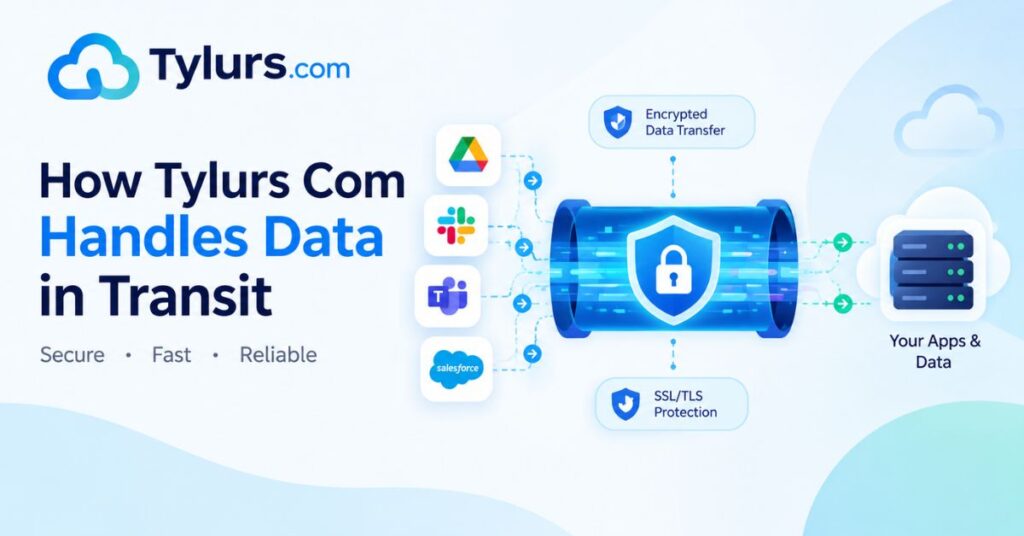
Data in transit simply means information moving from one place to another, like an order record traveling from your e-commerce app to your fulfillment tool. That journey needs to be both fast and secure, since sensitive details often pass through it, including names, addresses, and payment references.
Tylurs Com encrypts data while it moves between connected apps, so information stays unreadable to anyone who might intercept it along the way. This kind of protection has become standard practice across serious workflow platforms, and it’s one of the first things worth checking before connecting sensitive business data to any automation tool.
Data Protection and Security
Security isn’t a single feature. It’s a combination of encryption, access controls, and activity logging working together. Encryption protects data while it moves and while it sits in storage. Access controls make sure only the right people and apps can reach specific data. Activity logs give teams a record of what happened and when, which matters for troubleshooting and for compliance.
For a worldwide audience, compliance expectations vary by region. Businesses operating across borders should check how a platform handles data residency and regional privacy requirements, since rules like GDPR in Europe don’t look identical to data laws in other regions. A responsible platform builds its security practices to meet the stricter end of these expectations, not the loosest one.
Managing Data During High API Traffic
Traffic spikes test a system in ways normal days never do. Tylurs Com handles this through load balancing, spreading incoming requests across available resources instead of letting them pile up in one place. Combined with throttling, which paces out requests during extreme spikes, the system keeps workflows running instead of stalling out.
The goal isn’t to process everything instantly no matter what. It’s to keep the system reliable, even under pressure, so a workflow that normally takes two seconds doesn’t suddenly take two minutes during your busiest hour of the year.
See Also: Securly Pass: Complete Guide, Features & Benefits (2026)
How to Build a Tylurs Com Workflow
Building your first Tylurs Com workflow breaks down into three clear steps. None of them require a developer, though developers can go further if they want to.
| Step | What Happens |
| Connect your apps | Authenticate and link the tools you want to sync |
| Configure transfer rules | Map fields and set triggers between apps |
| Test and monitor | Run a test sync, then check logs once it’s live |
Connect Your Apps
Start by linking the apps you use most. This step usually means logging in through a secure connection, so Tylurs Com can read and write data on your behalf. Most teams begin with two apps, like a CRM and an email tool, before expanding to a wider set of connections.
Configure Data Transfer Rules
Once your apps are connected, decide what should trigger a workflow and what should happen next. This is where field mapping comes in, matching a “customer name” field in one app to the correct field in another. Getting this step right the first time saves a lot of cleanup later.
Test and Monitor Your Workflow
Before going live, run a test to confirm the workflow behaves as expected. Check that the right fields update and that nothing gets duplicated or skipped. After launch, keep an eye on the monitoring dashboard, since it flags failed syncs and lets you catch small issues before they turn into bigger ones.
Can Tylurs Com Support Custom Scripts?
Yes, with some nuance depending on who’s asking. No-code users can build powerful workflows using the built-in trigger-and-action system without writing a single line of code. Developers who need more control can add custom scripts to handle edge cases, complex logic, or unique formatting that the standard tools don’t cover.
This flexibility means Tylurs Com works for a solo founder connecting two simple apps and for a technical team running dozens of interconnected workflows across a growing stack. The learning curve stays low for beginners, while the ceiling stays high for teams that want to push further.
Where Tylurs Com Fits Into a Growing Tech Stack
Tylurs Com isn’t trying to replace your CRM, your accounting software, or your e-commerce platform. It works alongside them, acting as the connective layer that lets each tool do its job while staying in sync with everything else. Think of it less as a new department and more as the messenger running between departments that already exist.
That positioning matters as a business grows. New tools get added over time, and without a connective layer, each new app becomes another manual process to manage. With Tylurs Com in place, adding a new app usually means adding a new connection, not rebuilding your entire process from scratch.
See Also: Robthecoins Blockchain 2026: Powerful Features & Benefits
Scaling Workflows as Your Business Grows
A five-person team might run two or three simple workflows. A hundred-person company might run dozens, spanning sales, support, finance, and operations. Tylurs Com scales alongside that growth, since new workflows can be added independently without breaking the ones already running.
The key to scaling smoothly is organization. Businesses that name their workflows clearly and document their trigger rules avoid the tangled mess that can build up after a year of adding automations without a plan. A little structure early on saves a lot of confusion later.
When to Use Automated App Syncing
Automated syncing earns its keep in a few clear situations: high transaction volume, frequent handoffs between teams, and time-sensitive data that loses value if it’s a day old. A business processing hundreds of orders daily benefits enormously from real-time syncing between its store and its fulfillment system.
On the other hand, a very small operation with low volume and simple needs might not need full automation right away. It’s worth matching the tool to the actual size of the problem, rather than automating everything just because the option exists.
Tylurs Com Benefits for Businesses and Teams
The benefits of Tylurs Com show up differently depending on the role. Sales teams get faster handoffs to fulfillment and support. Support teams get full customer context without switching tools. Finance teams get accurate, current numbers instead of end-of-week reconciliations. Operations teams get visibility into what’s happening across every connected app in real time.
Taken together, these benefits add up to something bigger than time saved. They build a business that runs on accurate, current information instead of guesswork. That reliability becomes a real advantage once a company starts to scale, since manual processes that worked at a small size usually break down once volume increases.
Tylurs Com vs Scheduled App Syncing
Not every syncing method works the same way, and the difference matters more than it might first appear. The table below compares Tylurs Com’s real-time, event-driven approach against traditional scheduled syncing.
| Factor | Tylurs Com (Real-Time) | Scheduled Syncing |
| Data freshness | Updates instantly when a trigger fires | Updates only at set intervals |
| Setup complexity | Moderate, with guided configuration | Often simpler, but less flexible |
| Error handling | Flags issues as they happen | Errors may go unnoticed until the next run |
| Best for | High-volume, time-sensitive workflows | Low-volume, non-urgent data needs |
Scheduled syncing still has a place. A weekly report that doesn’t need to be current to the minute works fine on a schedule. But for anything time-sensitive, like order processing or customer support handoffs, real-time syncing through Tylurs Com keeps everyone working from current information instead of yesterday’s snapshot.
FAQs
What Is Tylurs Com Used For?
Tylurs Com is used to connect business apps and automate the flow of data between them. Businesses use it to eliminate manual data entry, speed up handoffs between teams, and keep information consistent across every connected tool.
How Does Tylurs Com Connect Business Apps?
Tylurs Com connects apps through secure authentication, then uses trigger-and-action rules to move data between them. Once connected, a change in one app can automatically update the corresponding record in another app.
How Does Tylurs Com Protect Data in Transit?
Tylurs Com encrypts data while it moves between connected apps, so information stays protected during transfer. This is combined with access controls and activity logging to support overall data security.
Can I Add Custom Scripts to Tylurs Com Workflows?
Yes. While most workflows run fine using the built-in trigger-and-action system, developers can add custom scripts for edge cases or advanced logic that standard tools don’t cover.
Is Tylurs Com Faster Than Scheduled App Syncing?
Yes, for time-sensitive data. Tylurs Com updates records the moment a trigger fires, while scheduled syncing waits for its next scheduled run. For anything urgent, real-time syncing keeps information current in a way scheduled syncing can’t match.
Final Thoughts
Disconnected apps cost businesses time, accuracy, and trust, one manual entry at a time. Tylurs Com closes that gap by connecting your tools, automating the handoffs between them, and keeping your data current no matter how fast your business moves. Whether you’re a small team linking two apps or a growing company managing dozens of workflows, the goal stays the same: less manual work, fewer errors, and a tech stack that finally works together.
If your team is still copying data by hand between tools, that’s usually the clearest sign it’s time to build your first workflow.

Ryan Mitchell is a writer and language enthusiast at MeaningZen. He creates simple guides on slang, word meanings, grammar, and modern internet language. His goal is to make confusing words and phrases easy to understand.